Gisel Sánchez
@giyisanchez
Comunicadora, activista y curiosa por los Derechos Humanos.
Gisel Sánchez
@giyisanchez
Comunicadora, activista y curiosa por los Derechos Humanos.

Disinformation and Polarization and Alternative Narratives and futures
"This polarization has led to a bizarre loss of touch with reality"
Make America Great Again / Yes we can: Sloganes provocadores sobre el futuro. El primero evoca un pasado que quizás nunca existió, pero fue mejor, y posiciona un escenario futuro al cual debemos tenerle miedo. El segundo lo afronta con más esperanza.
"what I took away from that year in Moscow and Leningrad
was less about the the subject I was studying and more my knowledge that in fact those who control a population
sense of reality or their imagination really controls them totally it they control what they can imagine what is possible and what is not possible in the world"
"the capacity of memory both Collective and individual to gloss over to improve on or distort the facts is particularly evident in periods when the foundations of society are collapsing these disorders to which memory is prey the tendency to embellish or suppress awkward detail the need to vindicate oneself show how dangerous it is to rely on one's own conviction of being right since this is all too often based on false criteria our main task is instead Define true criteria there's also the problem that while distorting our Recollections and thus hindering a proper appreciation of individual or historical experience memory is at the very core of our Humanity it is all that we have" - Cita de otra persona
Entrevistador: you state and I love this quote uh historical truth is antithetical to narrative satisfaction this runs counter to the incessantly repeated cliches about storytelling where we hear that stories make us human and that narratives help us create patterns and meaning you're not saying that you're saying that narrative satisfaction takes us away from Truth. where does storytelling take the wrong Fork where do good stories end and bad ones begin?
Ella: "well I will say that if you tell history as a as a narrative you have to adhere to the rules that Frank Cod mentioned in one of his books which is a narrative to be satisfying has to have a beginning a middle and an end and that the end has to harmonize with the beginning you can mess up the middle as much as you want and again I don't think there are endings in history I think everything keeps moving forward and I think the most productive way of of thinking about it one which actually is liberating is that what happened in the past is a place of departure it is not the end I do think that as people are
claiming space for their own identity in nowadays they mistakenly refer to my story telling my story and that means to me it connotes that one can shade some of the things that don't fit in with the narrative and I always object to the roughing out of the bad details or the good details I mean I think history is full of the good the bad ugly and the Beautiful so you have to get all of it or it isn't realistic I think that in terms of fiction you can you know really helps to have a narrative and that narratives can tell truths through fiction that are as profound as history but they're not to be mistaken for each other I also find it interesting Rick and maybe you do too that in the 20th century certainly in the modern era after the catastrophe of the first world war there was a rejection by most artists of the idea of a narrative that could make sense of anything in fact they wrote in an anti-narrative way because the world had ceased to make any sense that was their way of telling the truth so it's interesting to me now that storytelling has been revived I'm not sure that it's appropriate in every case and I think history is not a case where we should be telling stories"
Recomendaciones sobre mejores prácticas con nuestros teléfonos
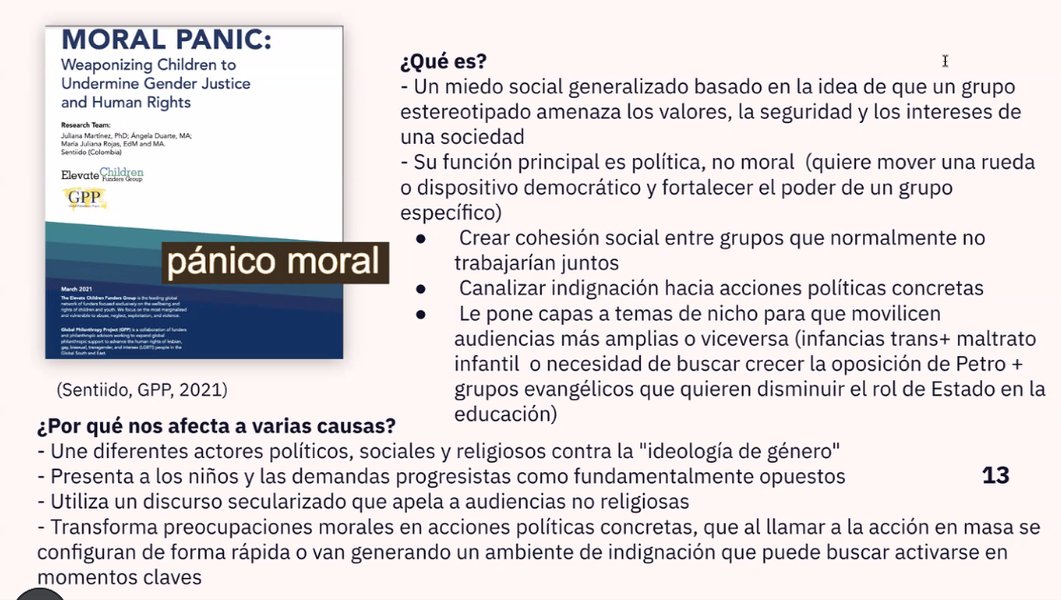
Disinformation and Polarization
#PánicoMoral Tomé esta captura de Uniendo Esfuerzos: Encuentro Regional para Neutralizar los Discursos en Contra de las Vidas Trans (PUENTES - CREO)