our preoccupation with facts – the information that links us to each other – perhaps causes us to disregard other ways of understanding meaning in our relationships, such as touch, intuition and facial expressions.
Co-Create Financial Planning Services for an Aging Population: Designers' Perspectives
Design considerations for creating financial planning toolkits and services for an aging population, based on co-creation workshops with designers from various disciplines.
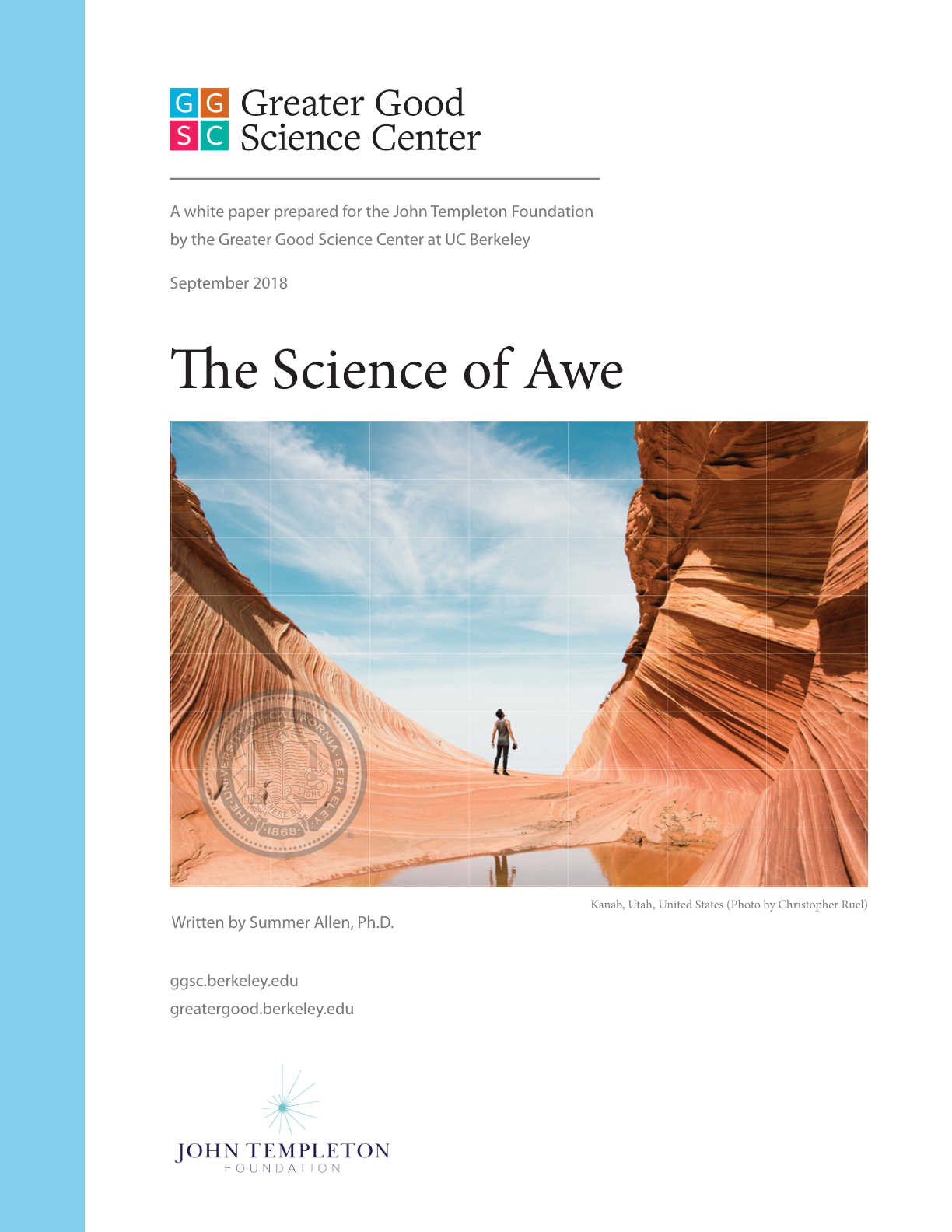
The Science of Awe: This white paper explores the nature of awe, what elicits it, who is more prone to experiencing it, and the effects it has on individuals.
the nervous system is not only a biological entity but also a complex network highly responsive to personal interests. This concept suggests that when individuals engage in activities they are genuinely interested in, their nervous system is more likely to respond positively, leading to increased focus, creativity, and overall well-being.
There is ongoing debate about whether UPFs should be considered addictive.9 Our analysis contributes to this debate by demonstrating how UPFs meet established addiction-science benchmarks, particularly when viewed through parallels with tobacco.
Particularly relevant to the idea of episodic simulation is the process of forming “implementation intentions” (Gollwitzer, 1999) which involve imagining and rehearsing a plan with reference to the specific future context in which it will be executed. Research has shown that creating implementation intentions significantly increases the likelihood... See more
Based on all this, we suggest that the function of dreams resides in their waking use – how they enable self-disclosure, for the benefit of the group, even if it can sometimes be uncomfortable for the individual. The remembering and telling of dreams is thus essential to their evolved function.
This suggests that the linear relationship between plausibility and hippocampal activity observed in the Weiler et al. study may not hold for the entire spectrum of plausibility. Instead, extremely implausible events may be associated with decreased hippocampal activity (relative to less implausible events), as observed in the current study where... See more