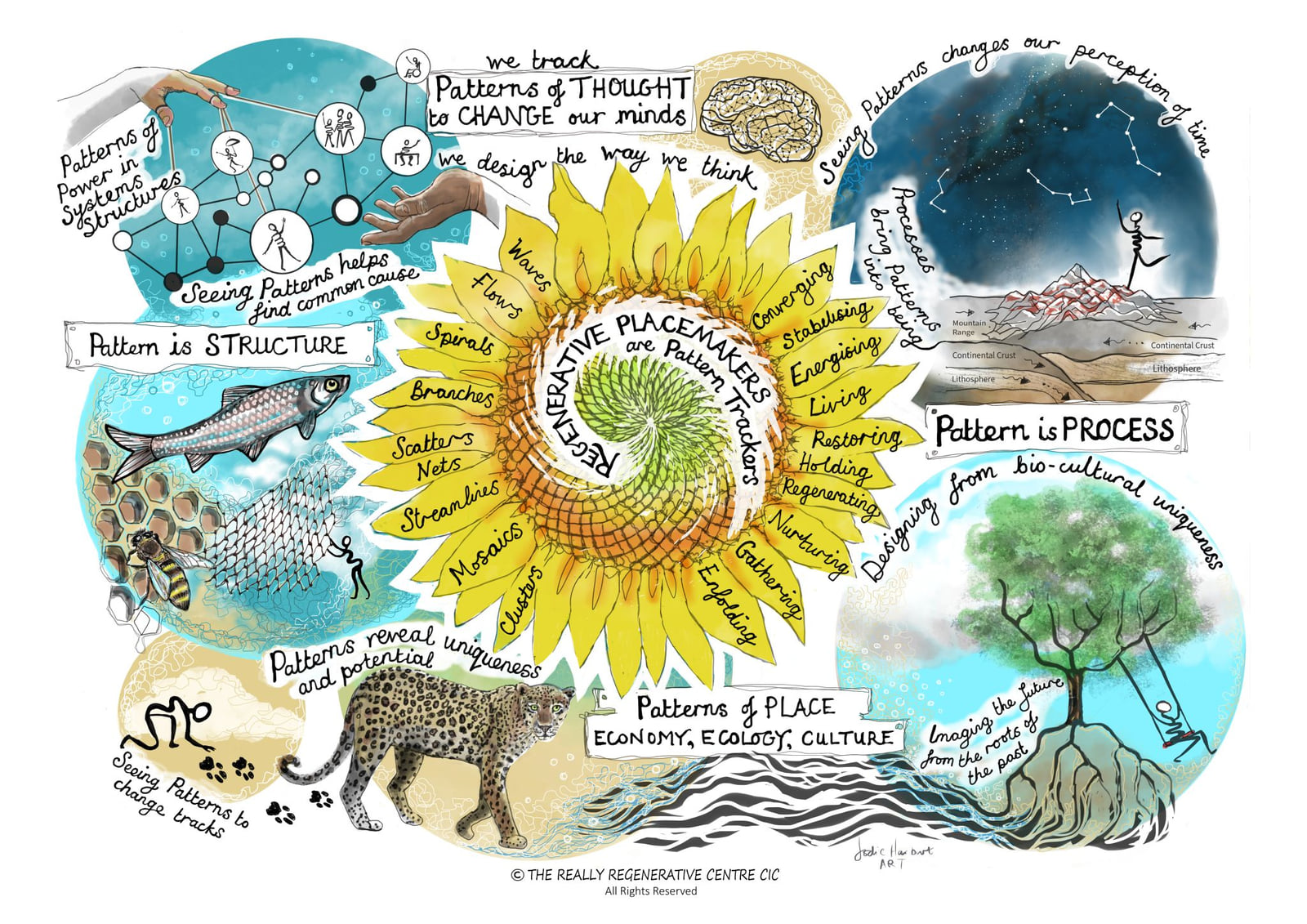
In praise of pattern literacy, another key attribute of regenerative practitioners. Some people have a particular talent for pattern and process but we can all learn to become better pattern trackers. We study pattern literacy because having a contextual understanding of the patterns and processes of People Place and System - and crucially how they change and evolve - is critical in designing systems evolution. Patterns are how we understand movement and process. All life is a process.
All living creatures are creatures of habit. Trackers track animals to notice their habits. So that they can be there waiting for them. Human beings are also creatures of habit. But unlike almost any other species, we can choose to change our habits. We can choose intentionally to work towards a regenerative mindset. When we commit to a practice of observing and tracking our own thinking, we can notice when we are not thinking from a living systems mindset, and disrupt ourselves, until such time as a regenerative mindset becomes and embodied habit.
There are new patterns emerging in local authority management in the UK today which have been growing or some time. The Starmer government is keen on further devolution of power from central to local authorities. Today an announcement of more future clustering of local authorities into larger entities or towards mayoral development authorities was announced.
There are other clusterings and poolings happening. UK tourism has reorganise ditself into larger governing bodies for consolidated regions, or Local Visitor Economy Partnerships (LVEPSs). In Sussex we have a new LVEP which has merged east and west Sussex tourism region.
At the Gatwick Economic conference, Gatwick Airport announced the formation of Gatwick Regional Economic Zone - an attempt to compensate for the fact that the south east has no mayoral authority to attract inward investment, and which will probably foreshadow the formation of one in the future. There was a great deal of discussion about development of industrial clusters which were appropriate for the region. These are not yet being thought about as bio-culturally aligned but at this stage driven by differentiation to be more 'competitive' compared to other regions. But it's still a chink of light because it does recognise regional diversity as important.
What we can see is real potential for greater regional resilience which most regenerative economic shapers propose as essential in the shift to regenerative futures. It holds the door open for a bioregional approach to be introduced and integrated into this future.
It also holds out the possibility that a regenerative cluster of innovative enterprises could be introduced, and centres - as lighthouse demonstrators of regenerative futures could form part of the future.
(cont below)