'How to make sure your brand strategist isn’t a numpty'
Three to four times a year, a founder contacts me to ask me what I think of a brand strategy they’ve just had delivered to them. The fact that they’re reaching out and asking me this question means that (a) they’re not sure what to think about it, which means it isn’t clear and (b) they, for whatever reason, didn’t feel its author could explain it either. Overall, not a great situation to be in.
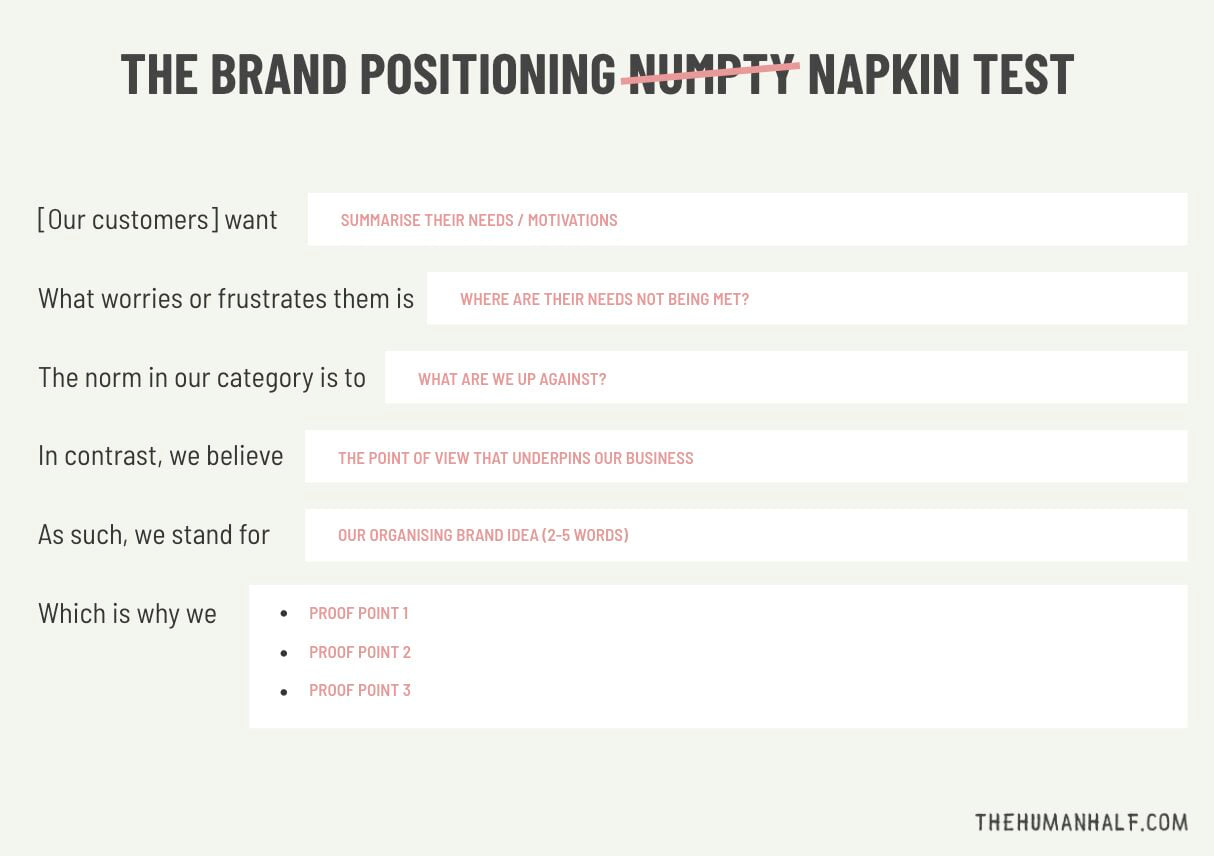
When I look at these presentations, they all share the same characteristics: they are long and meandering and most significantly, do not have a conclusion! If you’re a founder or CMO and you’ve recently experienced this, or are worried about it happening, here’s a napkin test you can send to your consultant.
Anyone who’s any good at all at brand positioning should be able to fill in this template with one sentence per answer. Two, max. (Perhaps remove the numpty bit from the title and write it in an email though).
There’s nothing particularly revolutionary in this template. It’s a reshuffle of the elements of a traditional positioning statement. But few people know what a positioning statement is these days, or know what to do with one. This format also makes it harder to hide because each element has to stand alone.
Now, the template might need a tweak for certain companies and categories. For example, not every brand needs a radically contrarian stance, you may be positioning your brand against a specific sub-category of competition etc. But if your strategist is smart they’ll be able to talk through those nuances and present something similarly straightforward.
I hesitated before deciding to post this because I don’t want to give anyone a hard time. But, frankly, there are some "brand strategists" out there giving some of us a bad name. Also, if you are an inexperienced brand strategist who is worried you might slip into meandering-and-no-conclusion trap, this is a useful test that will sharpen your skills.