An End to Upside Down Thinking: Dispelling the Myth That the Brain Produces Consciousness, and the Implications for Everyday Life
amazon.com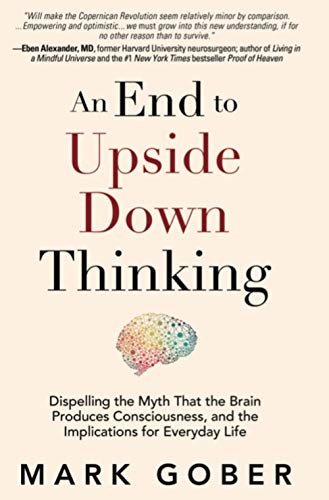
Saved by Claire Corbin and
An End to Upside Down Thinking: Dispelling the Myth That the Brain Produces Consciousness, and the Implications for Everyday Life
Saved by Claire Corbin and
We saw in chapter 8 that random number generators (RNGs) around the world can behave nonrandomly when many people are focused on the same thing at the same time. That begs the question: If we collectively decide to focus on the same thing at the same time as a large group, can we have an impact on the physical world? Can we do this to change the
... See moreThere is no doubt that artificial intelligence is becoming more sophisticated. But can the “range and subtlety” of human intelligence be replicated by a computer? The materialist view is that consciousness is produced by a material brain. So if we can create a brain-like machine, we should be able to create “conscious” artificial intelligence. In
... See moreOne has to wonder: Are the altered states of consciousness experienced in psychedelic trips and near-death experiences hallucinations? Or are they exposing us to some version of the “real” reality that is normally hidden by our limited brain?
Psychedelics produce an altered state of consciousness in which the user experiences a hyper-real reality that can be difficult to describe with words. Under the materialist view of consciousness, we might expect that these enriched experiences are caused by an increase in brain activity. A richer experience would be caused by more brain activity,
... See moreDiane Powell, a Johns Hopkins MD, former Harvard Medical School faculty member, and practicing neuropsychiatrist, has come to a similar conclusion. She thinks materialist neuroscience is on the wrong path by focusing on the brain when trying to understand consciousness: “Trying to understand consciousness by investigating the gray matter in our
... See moreWhat are the implications for world peace? If we are indeed what the evidence in this book suggests we are—an entangled, interconnected stream of infinite consciousness with no actual separation, with no beginning and no end—how might we act toward ourselves and others? How might we run businesses? How might we lead nations? But the dominant
... See moreIn light of these ideas, we should consider a statement made by the 14th Dalai Lama: In this century, human knowledge is extremely expanded and developed. But this is mainly knowledge of the external world. In the field of what we may call “inner science” there are many things, I think, that you do not know. You spend a large amount of the best
... See moreDr. Edith Ubuntu Chan, holistic medicine doctor and Harvard graduate, had a similar spontaneous awakening while in meditation. As she describes it: “One moment, I was sitting peacefully following a guided…meditation. Then the next moment…I experienced myself bursting…Bursting into trillions of pieces of Love and Light. I experienced myself the size
... See moreThe materialist view is that consciousness is produced by a material brain. So if we can create a brain-like machine, we should be able to create “conscious” artificial intelligence. In other words, we should be able to create machines that have feelings, thoughts, and a sense of experiencing their existences—a sense of “I.” And if these machines
... See more