grief
It wasn’t your fault, and it never was
Abuse is a cycle, one that victims rarely escape unscathed. In this devastating monologue, Rya (Amanda Seyfried) dismantles the cruel misconception that repeated trauma is just “bad luck”. Instead, it’s the result of a horrifying psychological and behavioural pattern ingrained in... See more
filmsyoushouldbewatchinginstagram.comno good alone - by rayne fisher-quann - internet princess no good alone
rayne fisher-quanninternetprincess.substack.com
“And here’s the thing about friction: it really does hurt. Isolationists have one very strong argument on their side — when you’re alone, there’s no one there to hurt you, even accidentally. There’s no one there to throw your own flaws into stark relief. There’s no one who you might hurt with bursts of uncontrollable emotion or human carelessness. It’s hard to be hurt, and perhaps even harder to hurt the people you love — why not cut the risk, lock the doors, and live a life of robotic, impersonal, action-oriented optimization? “
It is a cruel and fundamentally inhuman tragedy that the culture has convinced so many of us that we must be healed in isolation, because being surrounded by people — people who love us, or care for us, or are willing to sit in the same room with us while we clean up our messes — is about the only way that I, for one, have ever been able to get better. I am lucky enough to have been changed again and again and again by the people who have loved me or challenged me; I look back at the person I was at eighteen and I hardly recognize her, which feels like a miracle and a tragedy all at once.
When we insist that we could only ever effectively love someone who’s been perfectly “healed” — who will not struggle, accidentally hurt us, trigger us, say the wrong thing, do the wrong thing, or participate in any other uncomfortable display of humanity — we are reinforcing, and perhaps projecting, our own beliefs that we have to be perfect in order to be loved.
There is one way to reject this: make the choice to love someone who is as flawed as you are. One of the most remarkable pleasures that love has to offer, in fact, is the feeling of meeting someone who is scarred and beat-up and bruised, too emotional or not emotional enough or oscillating wildly between the two, and offering to love them enough to help them get better (and, of course, to have them do the same to you). To grow beside a friend or lover, knowing that you will poke and prod at each other as you take shape but unafraid of the resulting scar tissue — this is the good stuff.
Mary Oliver reciting her poem, ‘Wild Geese’ (1986), at a live poetry reading in 2012. Mary Oliver sadly passed away in January of 2019.
•
•
• Source: The 92nd Street Y, New York: “Mary Oliver Reads From a Thousand Mornings”, YouTube.... See more
coffee_with_keatsinstagram.com
I like reading philosophy because people say things like "you are tormented out of passion for what matters to you" and then it sticks with me forever. That's a line from a paper on grief as an ongoing, vocational, and dedicational activity by Line Ryberg Ingerslev.*
Ingerslev uses this term "vocational" to describe the... See more
Jessica Doresubstack.com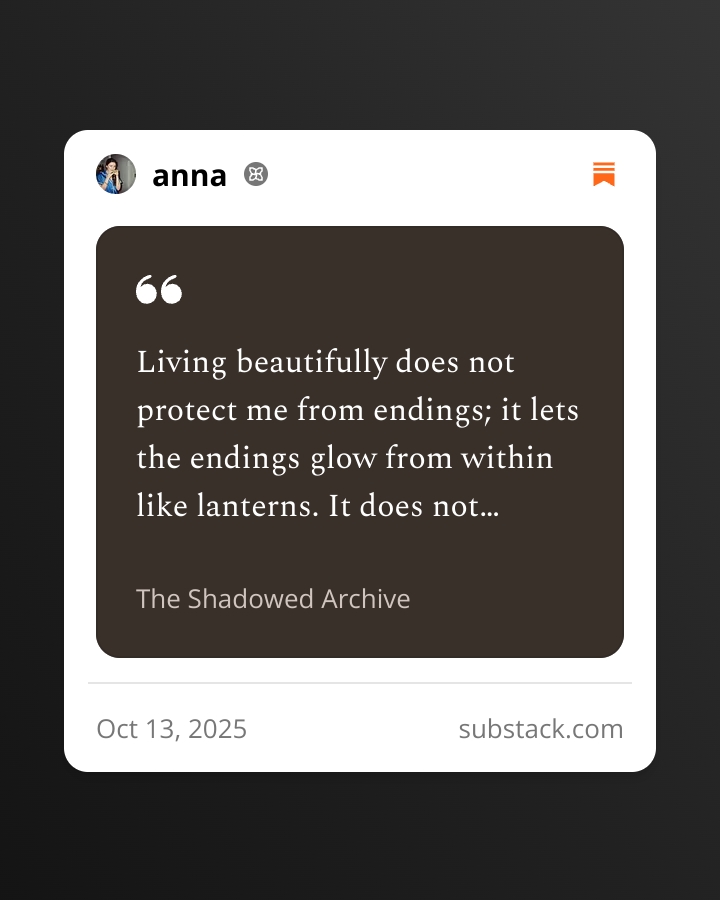
emotional hygiene is not another thing to do perfectly. it’s not about becoming immune to spirals or forever calm or unshakably centered. it’s about cleaning up often enough that you don’t mistake the mess for your personality. it’s about catching the overwhelm before it becomes a worldview. it’s about building the quiet skill of knowing when your... See more
milk and cookies • a guide to emotional hygiene for overthinkers
Surely, a person who calls off a wedding is meant to be sitting sadly at home, reflecting on the enormity of what has transpired and not doing whatever it is I am about to be doing that requires a pair of plastic clogs with drainage holes.
I need you to know: I hated that I needed more than this from him. There is nothing more humiliating to me than my own desires. Nothing that makes me hate myself more than being burdensome and less than self-sufficient. I did not want to feel like the kind of nagging woman who might exist in a sit-com.
These were small things, and I told myself it was stupid to feel disappointed by them. I had arrived in my thirties believing that to need things from others made you weak. I think this is true for lots of people but I think it is especially true for women. When men desire things they are “passionate.” When they feel they have not received something they need they are “deprived,” or even “emasculated,” and given permission for all sorts of behavior. But when a woman needs she is needy. She is meant to contain within her own self everything necessary to be happy.
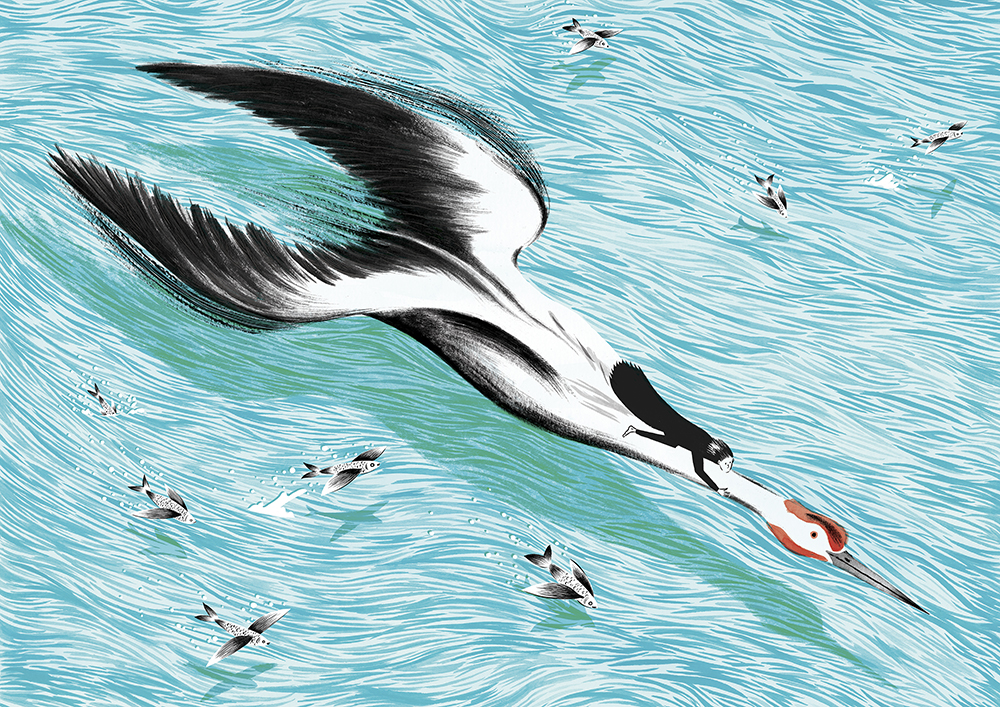
It turns out, if you want to save a species, you don’t spend your time staring at the bird you want to save. You look at the things it relies on to live instead. You ask if there is enough to eat and drink. You ask if there is a safe place to sleep. Is there enough here to survive?
Lindsay said it was brave not to do a thing just because everyone expected you to do it.
Tig Notaro honors her friend, @Andrea Gibson, with a reading of their poem, "Tincture."
#Colbert
colbertlateshowvt.tiktok.com