Consumer - brand//brand-consumer
Though nobody’s asking to go and chase Pokémon around the city in 2026, there are lessons to be learned about the value of big, flashy moments for cultivating communal experiences. “Fashion can learn from 2016’s embrace of spectacle as a uniting force,” Cummins says.
archive.is
2016 > 2026
From Unseriousness to Superfandom: Consumer Trend Predictions for 2026
Link
From consuming the product to becoming the product.
substack.com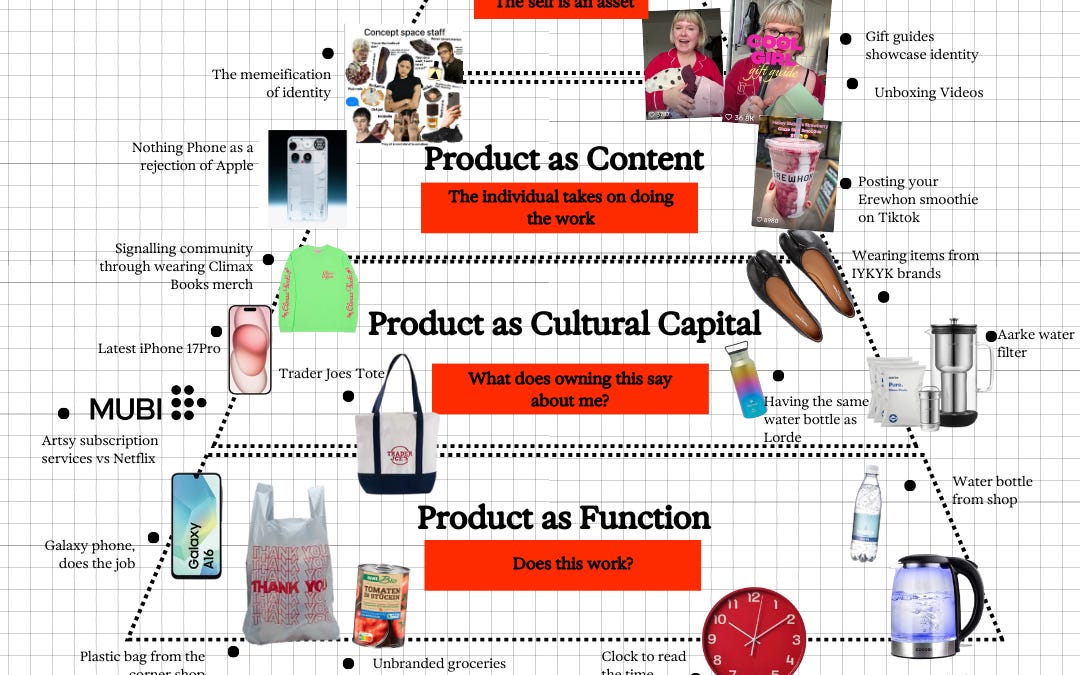
how buying the product is no longer the end of the shopping journey; it’s the entry point. The real work happens afterwards, in how ownership is made visible, narrated, and put into circulation.
The self becomes the medium through which brands acquire meaning, while individuals, often unintentionally, take on the work brands once did: positioning, differentiation, and proof.
From consuming the product to becoming the product.
Idea that the product is activated through the self. Products no longer brought for what they do - it’s about what they signal to others (Taste,Belonging,Discernment, Proximity to certain lifestyle etc). Economic shift:
Not just change in taste or behaviour
Quieter economic reorganisation occurring
Individual self becomes primary site of value creation
Ownership no longer end point of transaction – now the beginning of new kind of labour
Second, consumer expectations shifted irreversibly.
People now expect brands to be useful , not just meaningful. A 2024 Edelman study found that 67% of consumers define brand trust primarily through “helping me solve problems” rather than “sharing my values”—a complete inversion from 2015 when values alignment dominated. Cultural resonance still... See more
People now expect brands to be useful , not just meaningful. A 2024 Edelman study found that 67% of consumers define brand trust primarily through “helping me solve problems” rather than “sharing my values”—a complete inversion from 2015 when values alignment dominated. Cultural resonance still... See more
Adrian Barrow • Your Brand Can't Message Its Way Into Culture Anymore.
People now expect brands to be useful, not just meaningful