A new shape
‘In the technocracy, nothing is any longer small or simple or readily apparent to the non-technical man’, wrote Roszak. ‘Instead, the scale and intricacy of all human activities – political, economic, cultural – transcends the competence of the amateurish citizen and inexorably demands the attention of specially trained experts’. Technocrats might... See more
“Most decisions should probably be made with somewhere around 70% of the information you wish you had. If you wait for 90%, in most cases, you’re probably being slow. Plus, either way, you need to be good at quickly recognizing and correcting bad decisions. If you’re good at course correcting, being wrong may be less costly than you think, whereas... See more
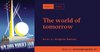
The subtitle of James Pethokoukis’s recent book The Conservative Futurist is ‘How to create the sci-fi world we were promised’. Like Peter Thiel’s famous complaint that ‘we wanted flying cars, instead we got 140 characters’, the phrase captures a sense of betrayal. Today’s techno-optimism is infused with nostalgia for the retro future.
This idea of progress acknowledges that as soon as we have something, however well it meets our original desires, we see its flaws. ‘Form follows failure’, in the words of civil engineering professor Henry Petroski. Dissatisfaction drives progress. ‘Since nothing is perfect’, writes Petroski, ‘and, indeed, since even our ideas of perfection are not... See more
The world of tomorrow - Works in Progress
Let’s assume that we will soon live in a world in which intelligence - narrowly defined - is cheap. In this world, any job that primarily depends on the manipulation of information - on a knowledge of rules, on conventional uses of language, on data-based analysis - comes under threat. Which qualities and attributes become relatively more valuable?... See more
The yearning to feel capable and in control shows up all over contemporary culture. We see it in the growth of cooking classes and of mixed martial arts, of weight lifting and craft hobbies, even blacksmithing. ‘It’s all things that make us use our hands, make us use tools, make us master something that seems beyond us at first’, Elizabeth... See more
“But,” I said, “when I see my work I take for granted what other people value in it. I see only its ineptitude, inorganic flaws, and crudities. I am not pleased or satisfied.”
“No artist is pleased.”
“But then there is no satisfaction?”
“No satisfaction whatever at any time,” she cried out passionately. “There is only a queer divine dissatisfaction, a... See more
“No artist is pleased.”
“But then there is no satisfaction?”
“No satisfaction whatever at any time,” she cried out passionately. “There is only a queer divine dissatisfaction, a... See more
Choreographer Agnes de Mille
thought without agency is just yearning, but acting without imagination is just busywork.
From Radar futurist collective