The Coming Enterprise Blockchain 2.0 Era and The Evolution of the L1 Trade.
My second near miss with crypto came in 2016 at Consensus. The key sponsors and speakers for the event were boring enterprises like IBM, Microsoft, and Deloitte. R3, an enterprise consortium chain, gave a mainstage presentation, and throughout... See more
Ryan Watkinsx.comThe Coming Enterprise Blockchain 2.0 Era and The Evolution of the L1 Trade. My second near miss with crypto came in 2016 at Consensus. The key sponsors and speakers for the event were boring enterprises like IBM, Microsoft, and Deloitte. R3, an enterprise consortium chain, gave a mainstage presentation, and throughout the industry there were murmurs of “blockchain, not Bitcoin.” We all know how things went since then. The first wave of enterprise blockchains died, while public blockchains achieved supremacy. It appears, so far, that the world really values permissionless, credibly-neutral, global assets and rails. Still some aspects of “blockchain, not Bitcoin” were right. Stablecoins became the industry’s killer use case beyond “non-sovereign store of value”. $300 billion on blockchains later, institutions are now giddy about putting every asset on blockchains. If we can upload dollars, make them programmable, and distribute them to the world, why can’t we do that with stocks, bonds, real estate, and more? And if we are going to do this, then why shouldn't large financial incumbents, that currently run the show, play a major role in driving this transition? In 2026 I anticipate there will be a fresh wave of excitement about enterprise blockchains, this time with the right regulatory and product tailwinds to work. Whereas public blockchains benefited from the Wild West before, attracting all the grey area experimentation enterprise blockchains could not, today the regulatory playing field is more even. Coinbase already has Base and hinted at launching a token next year. Stripe is incubating Tempo with the most elite list of partners since Facebook’s Libra. Circle is launching Arc with Visa among others. Robinhood is launching an L2 with Arbitrum. The Wall Street cabal is backing Canton, whose founders claim it already has $3 trillion in TVL. And this is just what’s already public. I expect the launch of these chains to trigger a wave of disillusionment among natives, while Wall Street bros celebrate and speculate that this is the future of the financial system. Should these chains launch tokens, they’ll probably also steal flows on the margins from our native chains. For good reason too. Most L1s, in contrast, are pointless and have no killer apps or distribution advantages. So is it all doomed? Probably not. I doubt any “enterprise chain” meta could sustain the hype for more than a moment. The reality is that 1) new ecosystems take a really long time to build out — on the order of years, not months. And 2) there will be real hurdles to onboarding non-insiders, who don’t want to line the pockets of their competitors. While I do think a winner may eventually emerge from the pack, and that its more likely the next major blockchain comes out this cohort than the native VC backed ones, I nevertheless remain skeptical how big they can become. The truth is, credible neutrality is a scaling advantage, not just an ideology. Just like how institutions globally choose Bitcoin for its reliability, neutrality, and ability to minimize long-term counterparty risk, they’ll also choose Ethereum and Solana. And the thing about credible neutrality, is that like all forms of trust, it can only be built over time. This is an enormous advantage for both Ethereum and Solana which have a 5 - 10 year head start over all these new chains. This provides a long runway to compound network effects before anyone even comes close to challenging them. And that’s assuming that it’s even possible for an enterprise chain to achieve credible neutrality in the long-run. So where does that leave us? I expect consolidation of flows, activity, and interest into the leading L1s while the long-tail bleeds out. Meanwhile Enterprise chains will win on the margins through expanding the market, not taking it. And in the long-run, I firmly believe the internet’s monetary and financial foundation will not be controlled. Long live public blockchains.
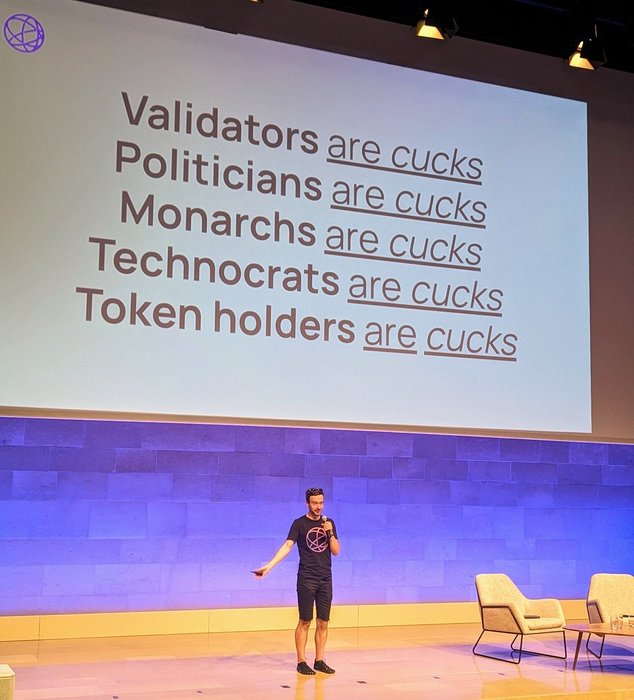
9 takeaways from ethcc:
1. The next evolution of the app-chain thesis is the cooperative-chain thesis. @owocki has called the latter "ecosystem chains" and they're a massive innovation for the space, enabling projects to *share revenue* for building on chains that support their values.
One... See more
The more time passes, the more I believe crypto natives have completely lost the plot on ETH and that’s it’s becoming impossible to replicate the product that Ethereum has built.
At this point, no other ecosystem is even attempting to create a WWIII-resistant, globally shared settlement system. And as we’ve come to understand, you can’t... See more
At this point, no other ecosystem is even attempting to create a WWIII-resistant, globally shared settlement system. And as we’ve come to understand, you can’t... See more
Ryan Watkins • Tweet
As discussed in my previous posts, there are myriad challenges to tackle before getting to mass adoption. Basic infrastructure, which has not proven itself ready for scale, sits at the core of these challenges. This is not too concerning in my opinion. The research, effort, brainpower, and capital that have been invested into this topic alone will... See more
Robert Hammond • Ponzi-as-a-Service (PaaS)
One of the driving insights that led me to leave my job in 2021 at Reddit, because of my interest in the crypto industry, because of my fascination with decentralization, and because of my, you know, belief that the ability to own and control and create and have access to all of the data that we as individuals create online. I didn't believe that I
... See more