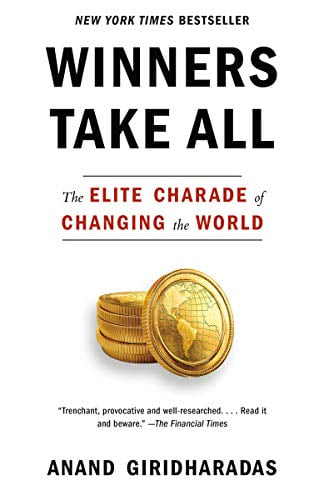
Winners Take All: The Elite Charade of Changing the World

A company not run purely in shareholders’ interests risked lawsuits from its investors. The dominant interpretation of corporate law, as we’ve seen, has since the 1970s come to regard companies’ first duty as being to earn a profit for shareholders. A company that put social goals ahead of business ones had no clear place in this regime.
Anand Giridharadas • Winners Take All: The Elite Charade of Changing the World
And so graduates like Cohen were bombarded not only by tales of economic woe and inequality, but also by an insistent message about how to defeat these scourges. They might have seen Morgan Stanley’s advertising campaign “Capital Creates Change,” in which it declares that “the value of capital is to create not just wealth but things that matter,”
... See moreAnand Giridharadas • Winners Take All: The Elite Charade of Changing the World
Hinton’s task at McKinsey shared a basic commonality with his work in Mongolia: He was to show up as an outsider and try to make good. But the experiences diverged starkly from there. In Mongolia, Hinton’s approach was to learn from the people he was studying by hanging back, observing, realizing all he didn’t know. Success required letting other
... See moreAnand Giridharadas • Winners Take All: The Elite Charade of Changing the World
one of B Lab’s great victories had been the creation of a parallel corporate law, first enacted in Maryland and then adopted in other states, that allowed companies to embed a social mission into their work without fear of legal trouble such as shareholder complaints. It was important to give good companies this protection. Kassoy, though, still
... See moreAnand Giridharadas • Winners Take All: The Elite Charade of Changing the World
assumption that what was good for them was good for everyone. Globalization, he argued,
Anand Giridharadas • Winners Take All: The Elite Charade of Changing the World
People like Asher were regularly told, and had come to believe, that there were less hostile ways of solving problems than systemic reform.
Anand Giridharadas • Winners Take All: The Elite Charade of Changing the World
The bigest opponents to reform will always be those benefit the most from the status quo
When Rockefeller proposed to establish his benevolent foundation to deal with his avalanche of money, powerful voices resisted, railing that the money was tainted by its origins. “No amount of charities in spending such fortunes can compensate in any way for the misconduct in acquiring them,” said President Theodore Roosevelt. Memories remained
... See moreAnand Giridharadas • Winners Take All: The Elite Charade of Changing the World
citizens of a democracy are collectively responsible for what their society foreseeably and persistently allows; that they have a special duty toward those it systematically fails; and that this burden falls most heavily on those most amply rewarded by the same, ultimately arbitrary set of arrangements.
Anand Giridharadas • Winners Take All: The Elite Charade of Changing the World
The businessperson’s amortization is factored into his tax bill, but what about the poet’s “amortization of the heart and soul”? The businessperson gets a break for his debts, but can the poet claim the same advantage for his indebtedness “to everything/about which/I have not yet written”?
Anand Giridharadas • Winners Take All: The Elite Charade of Changing the World
Vladimir Mayakovsky