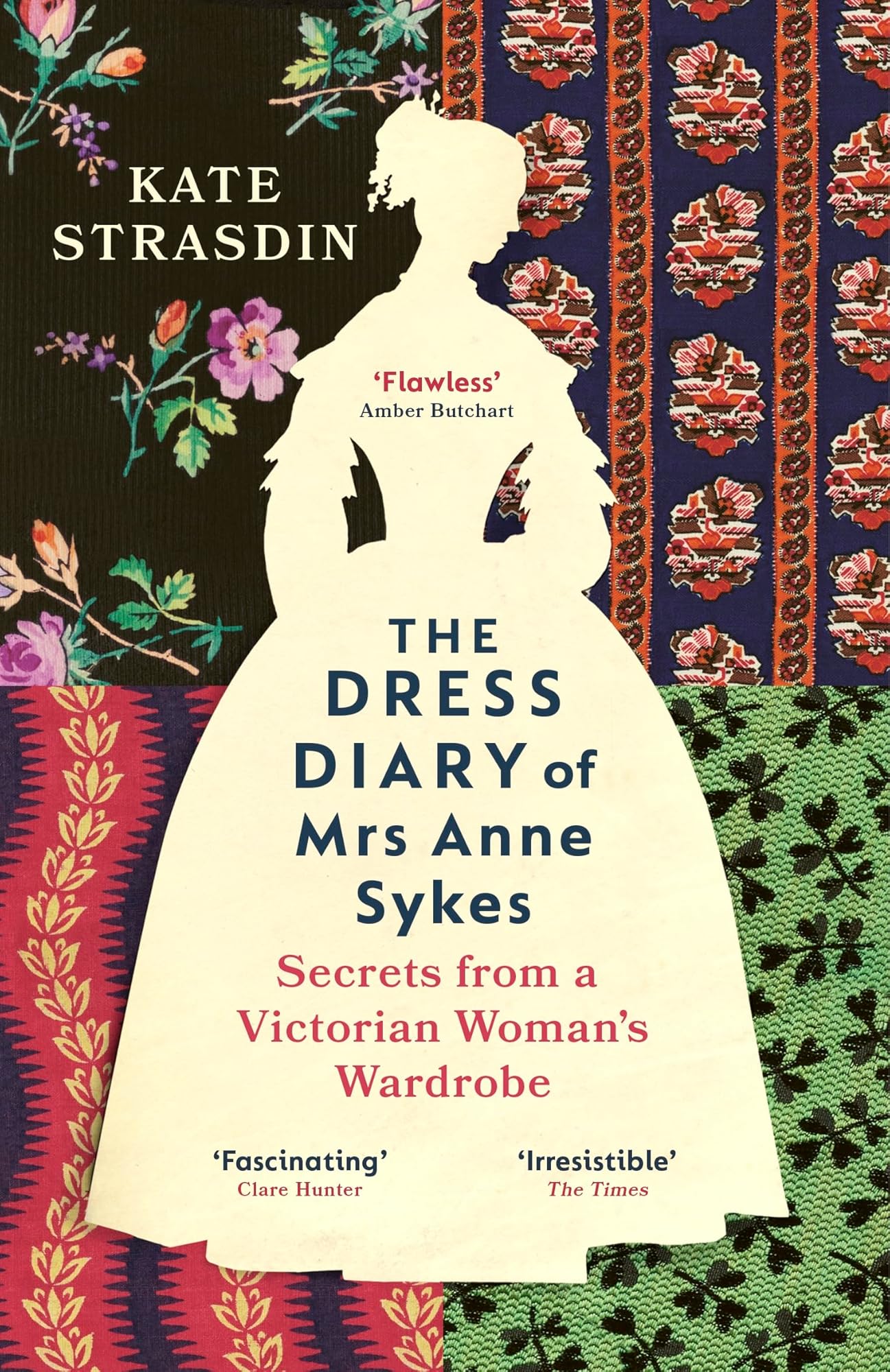
The Dress Diary of Mrs Anne Sykes
The unsmiling faces and the sepia tones drain their lives of colour and emotion. This has become a part of the popular chronicling of the nineteenth century, and yet to turn the pages of Anne’s album is to be let into a well-kept secret. These were not colourless people, but ones who lived in an age of technical innovation and fast-paced change.
... See moreKate Strasdin • The Dress Diary of Mrs Anne Sykes
On page 20 of the album a cotton dress fragment belonging to Mercy Taylor is described as being ‘printed at Primrose’. It is a shaded ombré – the process of colours graduating into one another – fading from the brightest magenta through to a paler shade and cut through at intervals with a wavy stripe in emerald green. If the four inches of fabric
... See moreKate Strasdin • The Dress Diary of Mrs Anne Sykes
Leopard print feels like a curiously modern trend, a fad that leapt into vogue from the 1950s onwards, but it has in fact been fashionable for far longer. This form of animal print had become especially popular in eighteenth-century France, with Louis Bosse’s flirtatious engraving La Matinée depicting a woman dressed in a loose robe decorated with
... See moreKate Strasdin • The Dress Diary of Mrs Anne Sykes
One of the most aesthetically dramatic fragments offers a small glimpse of this early domestic experience of Singapore, and of Anne’s decisions as a home-maker as she embarked on her new life. Page 54 of the album is dominated by two striking swatches. The first is a bright cerise figured damask labelled ‘Drawing room damask Singapore May 1841’,
... See moreKate Strasdin • The Dress Diary of Mrs Anne Sykes
When she wrote that caption, the single acknowledgement of her identity as the keeper of the diary’s contents – ‘Anne Sykes May 1840. The first dress I wore in Singapore, Nov 1840’ – she unwittingly allowed us into her world.
Kate Strasdin • The Dress Diary of Mrs Anne Sykes
Thomson hired a master under whose instruction he placed a number of apprentices to learn the trade of the engraver and thus keep all of his design processes in-house. The results of his visionary endeavours find themselves in Anne’s album. Early in the volume there is a striking cream-and-brown striped cotton interspersed with pale zigzags and
... See moreKate Strasdin • The Dress Diary of Mrs Anne Sykes
Anne brought together a huge variety of colours and styles that were the products of these designers at work, following contemporary trends. Some of the cottons feature coral motifs that mirrored the mid-nineteenth-century fascination with the natural world and the desire to discover and delineate species of flora and fauna. Some of the 1830s
... See moreKate Strasdin • The Dress Diary of Mrs Anne Sykes
Over the course of the next seven years Anne would include seventeen vests that belonged to Adam during their time abroad. Unlike the majority of the other garments recorded in the diary, she was likely to offer details of their origins. Against a cream-and-brown floral silk, Anne wrote, ‘Adam’s favourite vest new in 1841 p. “Friends”’, referring
... See moreKate Strasdin • The Dress Diary of Mrs Anne Sykes
Blond lace originated in France, and rather than being woven from cotton, it was a pale-cream silk thread that lent the resulting cloth an elegant sheen that was perfectly captured in candlelight, icing their evening gowns.