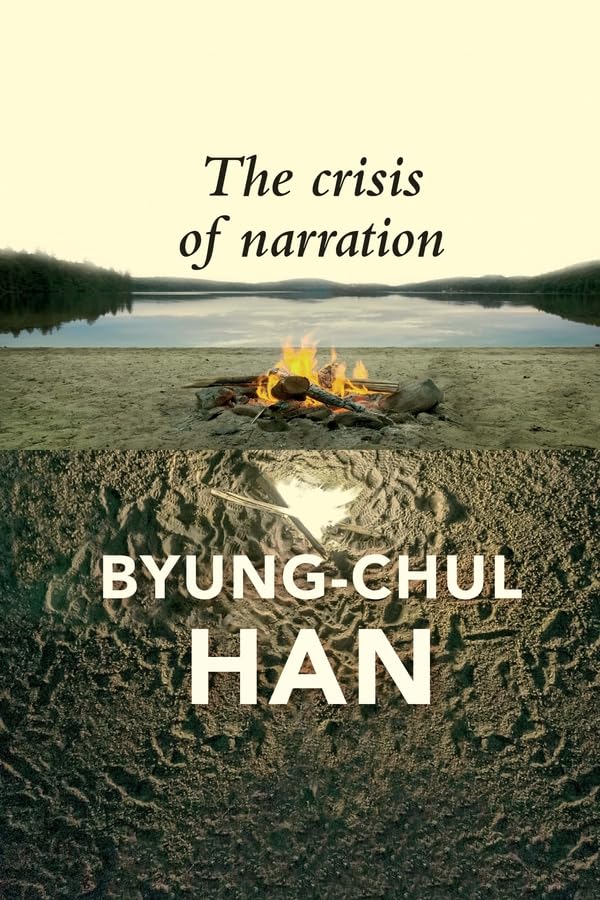
The Crisis of Narration
In late modernity, which is characterized by opening up and unbounding, forms of concluding and closing off are increasingly eroded.
Byung-Chul Han • The Crisis of Narration
Narration and remembrance cause each other. Someone who lives completely in the moment cannot narrate anything.
Byung-Chul Han • The Crisis of Narration
It is effective only for a moment. Bits of information are like specks of dust, not seeds of grain. They lack germinal force. Once they are registered, they immediately sink into oblivion,
Byung-Chul Han • The Crisis of Narration
Because it removes reality’s gaze, the smartphone is a most efficient tool for screening us off from reality. Reality’s gaze is the gaze through which the other addresses us. Reality as something facing us disappears entirely behind the touchscreen. Deprived of its otherness, the other becomes consumable.
Byung-Chul Han • The Crisis of Narration
It is precisely because artificial intelligence is incapable of passion, of passionate narration, that it cannot think.
Byung-Chul Han • The Crisis of Narration
This entire book is really nothing but an amusement after long privation and powerlessness, the jubilation of returning strength, of a reawakened faith in a tomorrow and a day after tomorrow, of a sudden sense and anticipation of a future, of impending adventures, of reopened seas, of goals that are permitted and believed in again.7
Byung-Chul Han • The Crisis of Narration
Information lacks the solidity of being.
Byung-Chul Han • The Crisis of Narration
Adrift in the sea of information and data, we seek a narrative anchor.
Byung-Chul Han • The Crisis of Narration
The self is not a quantity but a quality. ‘Self-Knowledge through Numbers’ is an illusion. Self-knowledge can be generated only through narration. I must narrate myself. But numbers do not narrate anything.