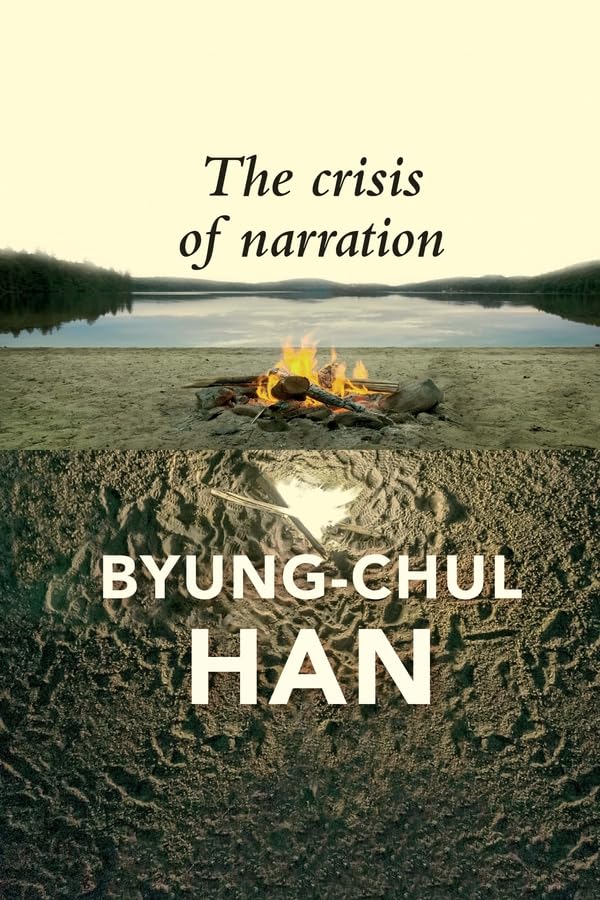
The Crisis of Narration
It is precisely because artificial intelligence is incapable of passion, of passionate narration, that it cannot think.
Byung-Chul Han • The Crisis of Narration
This entire book is really nothing but an amusement after long privation and powerlessness, the jubilation of returning strength, of a reawakened faith in a tomorrow and a day after tomorrow, of a sudden sense and anticipation of a future, of impending adventures, of reopened seas, of goals that are permitted and believed in again.7
Byung-Chul Han • The Crisis of Narration
‘Gay Science’: this signifies the saturnalia of a mind that has patiently resisted a terrible, long pressure – patiently, severely, coldly, without yielding, but also without hope – and is now all of a sudden attacked by hope, by hope for health, by the intoxication of recovery.
Byung-Chul Han • The Crisis of Narration
Data-driven human sciences [Geisteswissenschaften] are not sciences of spirit but data science. Data drive out spirit. Data-knowledge marks the degree zero of spirit. In a world saturated with data and information, our narrative capacity withers. Fewer theories are therefore formulated – no one wants to take the risk of putting forward a theory.
Byung-Chul Han • The Crisis of Narration
Intelligence computes and counts. Spirit, however, recounts.
Byung-Chul Han • The Crisis of Narration
Because it removes reality’s gaze, the smartphone is a most efficient tool for screening us off from reality. Reality’s gaze is the gaze through which the other addresses us. Reality as something facing us disappears entirely behind the touchscreen. Deprived of its otherness, the other becomes consumable.
Byung-Chul Han • The Crisis of Narration
‘In the protective eye, there is no daydreaming surrender to distance and to faraway things.’
Byung-Chul Han • The Crisis of Narration
If consciousness succeeds in parrying the shock, the impact of the occurrence is weakened, and it becomes an event. In the modern age, the shock aspect of individual impressions has become so intensified that our consciousness is forced to be permanently active as a shield against stimuli. The more it succeeds in this endeavour, the less the
... See moreByung-Chul Han • The Crisis of Narration
Consciousness prevents stimuli from reaching the deeper layers of the psyche. When consciousness’s protection against stimuli fails, we suffer a traumatic shock. Dreaming and remembering are delayed ways of coming to terms with such shocks.