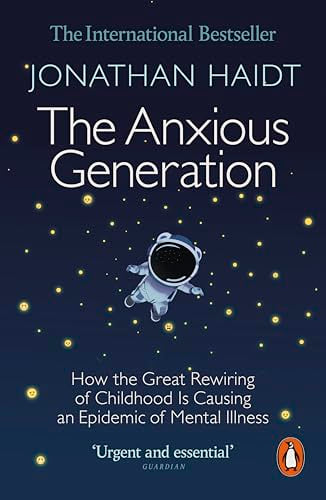
The Anxious Generation: How the Great Rewiring of Childhood Is Causing an Epidemic of Mental Illness
amazon.com
The Anxious Generation: How the Great Rewiring of Childhood Is Causing an Epidemic of Mental Illness

It’s as if we gave our infants iPads loaded with movies about walking, but the movies were so engrossing that kids never put in the time or effort to practice walking.
Life on the platforms forces young people to become their own brand managers, always thinking ahead about the social consequences of each photo, video, comment, and emoji they choose. Each action is not necessarily done “for its own sake.” Rather, every public action is, to some degree, strategic.
When people are raised in a community that they cannot easily escape, they do what our ancestors have done for millions of years: They learn how to manage relationships, and how to manage themselves and their emotions in order to keep those precious relationships going.
My central claim in this book is that these two trends—overprotection in the real world and underprotection in the virtual world—are the major reasons why children born after 1995 became the anxious generation.
Marcus Aurelius’s advice to himself, in the second century CE: Don’t waste the rest of your time here worrying about other people—unless it affects the common good. It will keep you from doing anything useful. You’ll be too preoccupied with what so-and-so is doing, and why, and what they’re saying, and what they’re thinking, and what they’re up to,
... See moreHere is Epictetus, in the first century CE, lamenting the human tendency to let others control our emotions: If your body was turned over to just anyone, you would doubtless take exception. Why aren’t you ashamed that you have made your mind vulnerable to anyone who happens to criticize you, so that it automatically becomes confused and upset?19
What emerged on campus as emotional safety, in contrast, was a much broader concept that came to mean this: I should not have to experience negative emotions because of what someone else said or did. I have a right not to be “triggered.”
Experience, not information, is the key to emotional development. It is in unsupervised, child-led play where children best learn to tolerate bruises, handle their emotions, read other children’s emotions, take turns, resolve conflicts, and play fair. Children are intrinsically motivated to acquire these skills because they want to be included in
... See more