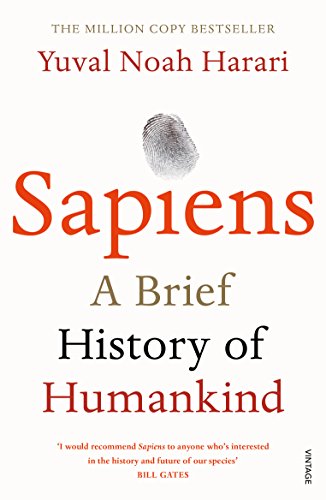
Sapiens: A Brief History of Humankind
Back then, each British city and town had its own local time, which could differ from London time by up to half an hour. When it was 12:00 in London, it was perhaps 12:20 in Liverpool and 11:50 in Canterbury.
Yuval Noah Harari • Sapiens: A Brief History of Humankind
The main ambition of the Nazis was to protect humankind from degeneration and encourage its progressive evolution. This is why the Nazis said that the Aryan race, the most advanced form of humanity, had to be protected and fostered, while degenerate kinds of Homo sapiens like Jews, Roma, homosexuals and
Yuval Noah Harari • Sapiens: A Brief History of Humankind
Bonobo and elephant societies are controlled by strong networks of cooperative females, while the self-centred and uncooperative males are pushed to the sidelines. Though bonobo females are weaker on average than the males, the females often gang up to beat males who overstep their limits. If this is possible among bonobos and elephants, why not
... See moreYuval Noah Harari • Sapiens: A Brief History of Humankind
But these seemingly benign principles have a dark side. When everything is convertible, and when trust depends on anonymous coins and cowry shells, it corrodes local traditions, intimate relations and human values, replacing them with the cold laws of supply and demand.
Yuval Noah Harari • Sapiens: A Brief History of Humankind
The large societies found in some other species, such as ants and bees, are stable and resilient because most of the information needed to sustain them is encoded in the genome.
Yuval Noah Harari • Sapiens: A Brief History of Humankind
Long after the Indo-Aryan invasion was forgotten, Indians continued to believe in the caste system and to abhor the pollution caused by caste mixing. Castes were not immune to change. In fact, as time went by, large castes were divided into sub-castes. Eventually the original four castes turned into 3,000 different groupings called jati (literally
... See moreYuval Noah Harari • Sapiens: A Brief History of Humankind
millions of African slaves to work the mines and plantations of America. They chose to import slaves from Africa rather than from Europe or East Asia due to three circumstantial factors.
Yuval Noah Harari • Sapiens: A Brief History of Humankind
The key factor was that the plant-seeking botanist and the colony-seeking naval officer shared a similar mindset. Both scientist and conqueror began by admitting ignorance – they both said, ‘I don’t know what’s out there.’ They both felt compelled to go out and make new discoveries. And they both hoped the new knowledge thus acquired would make
... See moreYuval Noah Harari • Sapiens: A Brief History of Humankind
Telling effective stories is not easy. The difficulty lies not in telling the story, but in convincing everyone else to believe it. Much of history revolves around this question: how does one convince millions of people to believe particular stories about gods, or nations, or limited liability companies? Yet when it succeeds, it gives Sapiens
... See more