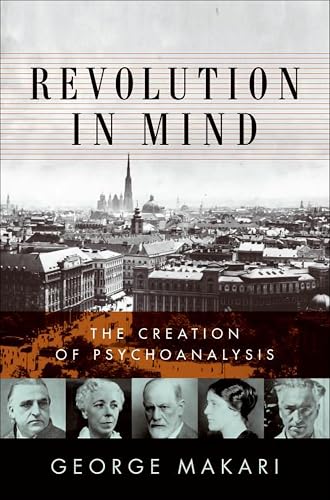
Revolution in Mind: The Creation of Psychoanalysis
However, Freud was not just saying that molested children became hysterical. He claimed that childhood molestations quietly festered for years before causing adult hysteria. Like syphilis, this latent disruption broke out in mental illness only later in life. Freud reasoned that the event remained quiescent and only gathered pathogenic force with
... See moreGeorge Makari • Revolution in Mind: The Creation of Psychoanalysis
Different upbringing. Different milieu. Different scientific premises. In that mouthful, Jung pierced to the heart of the differences between the Zurich and Viennese Freudians. One group was Jewish, the other Protestant. One group resided in sexually open Vienna, the other in buttoned-down Zurich. One had a foot in biophysics and psychophysics, and
... See moreGeorge Makari • Revolution in Mind: The Creation of Psychoanalysis
If the royal road to the unconscious was dreams, the everyday path was transference.
George Makari • Revolution in Mind: The Creation of Psychoanalysis
Suggestibility was simply a preverbal form by which affects were communicated, a form that commenced with the bonding of mother and child. It was a normal transfer of feelings from one to another.
George Makari • Revolution in Mind: The Creation of Psychoanalysis
Stekel also brought his ideas to the Wednesday group, where he did not hide his differences with the Professor. Psychic conflict, he insisted, was essential to all anxiety neuroses; these disorders were the result of a conflict between a life and death force, which he called “Eros” and “Thanatos.”
George Makari • Revolution in Mind: The Creation of Psychoanalysis
As head of the I.P.A., entrusted with extraordinary power to decide who was and who wasn’t a Freudian, it seemed Jung would never be outflanked again. For life.
George Makari • Revolution in Mind: The Creation of Psychoanalysis
Intellectualization could act as a defense against instinctual dangers and be a force for maintaining the status quo, but it was also an essential requirement for comprehending reality. Similarly, a defensive retreat into fantasy could not be reduced to a denial of reality alone; it might also hold the seeds of imagining new possibilities and serve
... See moreGeorge Makari • Revolution in Mind: The Creation of Psychoanalysis
He proposed creative solutions to long-standing problems that split those older fields, and then, in 1905, he pulled together an overarching synthesis that consolidated his prior work into a new Freudian field. Over the next decades, men and women migrated from those other disciplines to Freud. In this way, it can be said that Sigmund Freud did not
... See moreGeorge Makari • Revolution in Mind: The Creation of Psychoanalysis
He reasoned that sexual molestation might result in different neuroses if the assaults occurred at different developmental periods. Sexual assaults could lead to hysteria (if they occurred during ages birth to four), obsessional neurosis (ages four to eight), and paranoia (ages eight to fourteen).