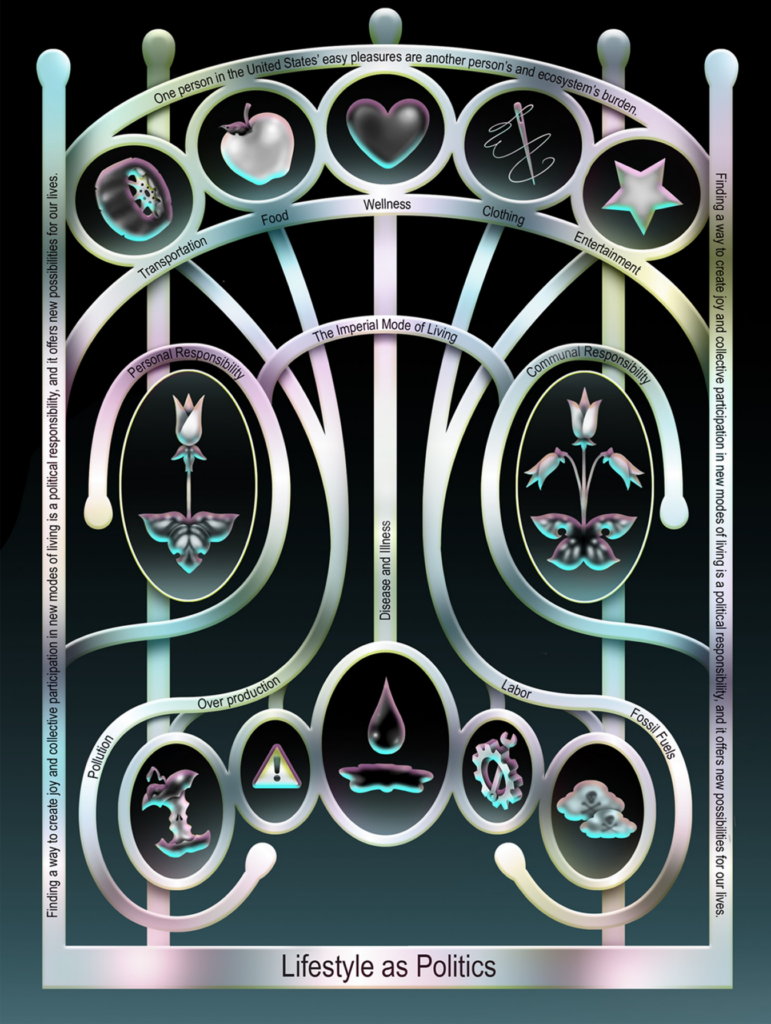
Finding a way to create joy and collective participation in new modes of living is a political responsibility, and it offers new possibilities for our lives.
How we live our lives, how we choose to move around the world and consume, has effects: Maybe we just feel slightly better, maybe we influence change in our immediate communities, maybe that change in our communities causes local policy change and eventual regulation of deeply destructive industries.
While that would be fantastic, it feels more and more impossible without “collective social change”; these changes can occur through shifting norms and habits that will thus influence broader policy. “Shifts in development pathways result from both sustained political interventions and bottom-up changes in public opinion,” the report says.... See more
When we say that changes only have to occur on the level of big policy and systems, we leave out the significance of public participation and the fact that how we each live our lives is part of a greater whole.
In the United Nations’ IPCC most recent climate change mitigation report, the word “lifestyle” appears 193 times. The authors write, “The acceptability of collective social change over a longer term towards less resource intensive lifestyles, however, depends on the social mandate for change. This mandate can be built through public participation,... See more
One person in the United States’ easy pleasures are another person’s and ecosystem’s burden. This is what writers Markus Wissen and Ulrich Brand have called “the imperial mode of living.” Their book of the same name breaks down “how normality is produced precisely by masking the destruction in which it is rooted,” and this sense of normality... See more
it’s ever more important for those who have economic ability and cultural capital to model behaviors that make treading lightly seem easy and desirable, to show that what has been proffered as “restriction” actually houses possibility for pleasure and connection, as well as a foundation for bigger change. Consumption as we know it, based on the... See more
Recipes, in particular, could be written in ways that push people toward different understandings of access, regionalism, and seasonality. They can force a reckoning between the false universality of the American supermarket and one’s actual regional food system. But that’s only if they’re written in a way that challenges dependence upon the animal... See more