Postmodernism for STEM Types: A Clear-Language Guide to Conflict Theory
This dynamic explains a puzzle about intellectual discourse: why do some thinkers resort to esoteric or Straussian writing - deliberately obscuring their ideas from public view?
The answer becomes clear through this framework. Academic seminars, private discussions, and carefully-gated intellectual spaces allow more tolerance for idea exploration... See more
Alex Steiner • Postmodernism for STEM Types: A Clear-Language Guide to Conflict Theory
Saying “I’m just asking questions” or “I’m just being logical” doesn’t exempt you from the impact of directing attention toward claims that hurt others. Truth alone isn’t virtuous when you’re choosing which truths to emphasize in a zero-sum conflict. The conflict theorist asks: negative impact on whom? If you accept that trans rights are a live... See more
Alex Steiner • Postmodernism for STEM Types: A Clear-Language Guide to Conflict Theory
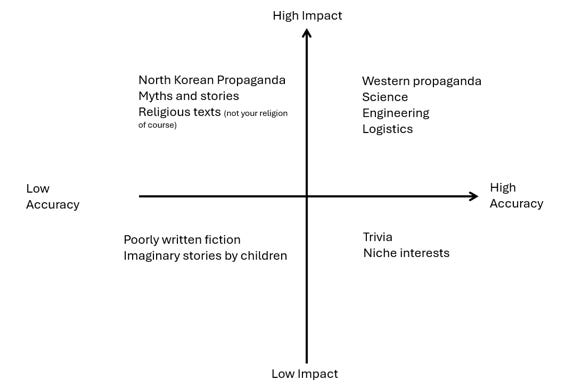
Mistake theorists are good at building. They can create complex technology, advance science, engineer solutions to technical problems. This requires genuine accuracy - you can’t fake your way through nuclear physics or software development. Reality punishes deviations from truth too quickly and consistently.
But mistake theorists are terrible at... See more
Alex Steiner • Postmodernism for STEM Types: A Clear-Language Guide to Conflict Theory
The Epistemological Progression
Epistemology asks: What should you believe? Different traditions give different answers:
Correspondence Theory /Mistake Theory : Believe what corresponds to reality.
Pragmatism : Believe what is useful.
Conflict Theory/ Post Modernism : Believe what is useful but ask first useful to whom?
Epistemology asks: What should you believe? Different traditions give different answers:
Correspondence Theory /Mistake Theory : Believe what corresponds to reality.
Pragmatism : Believe what is useful.
Conflict Theory/ Post Modernism : Believe what is useful but ask first useful to whom?
Alex Steiner • Postmodernism for STEM Types: A Clear-Language Guide to Conflict Theory
When postmodernists deconstruct terms, question categories, and insist on examining the political implications of seemingly neutral language, they’re not being needlessly academic. They’re recognizing that the battle over how we describe the world is the battle over what the world becomes. Categories aren’t discovered - they’re imposed. And once... See more
Alex Steiner • Postmodernism for STEM Types: A Clear-Language Guide to Conflict Theory
When a conflict theorist encounters a statement, they ask: “What is this statement meant to achieve in the world?”
This represents a fundamental shift from evaluating truth to evaluating effect. In mistake theory, correspondence to reality is primary - does this map match the territory? In conflict theory, the causal impact is primary - what does... See more
Alex Steiner • Postmodernism for STEM Types: A Clear-Language Guide to Conflict Theory
This is actually so helpful, as one of the STEM types
Science advances. Engineering produces results. Systems get built. The reason STEM fields can construct increasingly complex systems - from semiconductors to satellites to the internet - is because accurate maps are prerequisite for building on previous work. When your foundations are off, errors compound. You can’t build complex systems without... See more
Alex Steiner • Postmodernism for STEM Types: A Clear-Language Guide to Conflict Theory
The mistake theory framework assumes you can evaluate statements by checking them against reality - both in describing what exists now and predicting what happens next. Someone makes a claim, you gather evidence, you assess correspondence, you test predictions. The statement is either more true or more false, and this can be determined through... See more
Alex Steiner • Postmodernism for STEM Types: A Clear-Language Guide to Conflict Theory
Mistake theory
When a mistake theorist encounters a statement, they ask: “Does this correspond to reality?”
This is the map-territory distinction. Good maps reflect the territory accurately. Bad maps don’t. The goal of discourse is building better maps - more accurate models of the world. Truth is correspondence between map and territory.