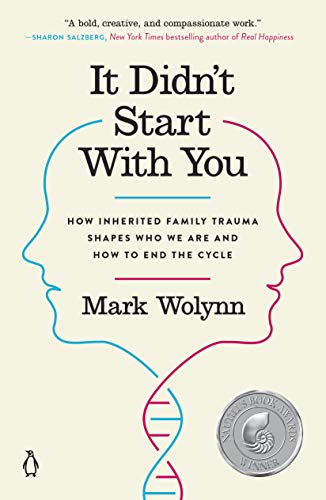
It Didn't Start with You: How Inherited Family Trauma Shapes Who We Are and How to End the Cycle
amazon.com
It Didn't Start with You: How Inherited Family Trauma Shapes Who We Are and How to End the Cycle

Core language can have the quality of coming from outside us while being experienced inside us.
Hellinger believed that the mechanism behind these repetitions is unconscious loyalty, and viewed unconscious loyalty as the cause of much suffering in families.
Researchers are now finding that our thoughts, inner images, and daily practices, such as visualization and meditation, can change the way our genes express,
the effects of traumas we inherit or experience firsthand can not only create a legacy of distress, but also forge a legacy of strength and resilience that can be felt for generations to come.
Sleeping inside each of them were fragments of traumas too great to be resolved in one generation.
An intellectual understanding by itself is rarely enough for a lasting shift to occur. Often, the awareness needs to be accompanied by a deeply felt visceral experience.
As with many stories of healing and transformation, what started out looking like adversity was actually grace in disguise.
Adam Gopnik writes about the difference between gurus and teachers in his book Through the Children’s Gate: “A guru gives us himself and then his system; a teacher gives us his subject and then ourselves.” The great teachers understand that where we come from affects where we go, and that what sits unresolved in our past influences our present.
... See moreWhether we inherit our parents’ emotions in the womb, or they are transmitted in our early relationship with our mother, or we share them through unconscious loyalty or epigenetic changes, one thing is clear: life sends us forward with something unresolved from the past.