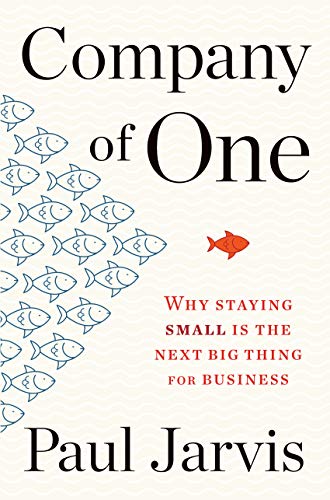
Company Of One: Why Staying Small Is the Next Big Thing for Business
In the United States, the number of non-employee establishments (people who work for themselves and have no employees) with an annual revenue of $1 million grew by nearly 6 percent in 2015, according to the U.S. Census Bureau.
Paul Jarvis • Company Of One: Why Staying Small Is the Next Big Thing for Business
We too often compare our sometimes messy selves to only the best and shiniest part of others and come up short.
Paul Jarvis • Company Of One: Why Staying Small Is the Next Big Thing for Business
training managers in a specific set of traits improved their charismatic qualities
Paul Jarvis • Company Of One: Why Staying Small Is the Next Big Thing for Business
Being predictable means that simple products are easy to instantly understand. A product that solves a single problem, like a Casper mattress helping you get a good night’s sleep, is simple.
Paul Jarvis • Company Of One: Why Staying Small Is the Next Big Thing for Business
Typically, as companies gain success or traction, they grow by taking on additional complexities. These complexities can often detract from a business’s original or primary focus, resulting in more costs and the investment of more time and money.
Paul Jarvis • Company Of One: Why Staying Small Is the Next Big Thing for Business
Miles Kington, a British journalist, reportedly said that “knowledge is knowing that a tomato is a fruit. Wisdom is not putting it in a fruit salad.”
Paul Jarvis • Company Of One: Why Staying Small Is the Next Big Thing for Business
my freedom of choice—is what’s driven me forward.
Paul Jarvis • Company Of One: Why Staying Small Is the Next Big Thing for Business
In Japanese, shinise is the word for a long-lasting company. Interestingly, about 90 percent of all businesses worldwide that are more than 100 years old are Japanese. They all have fewer than 300 employees, and the ones that still exist never grow quickly or without great reason.
Paul Jarvis • Company Of One: Why Staying Small Is the Next Big Thing for Business
Finally, leaders need to practice gratitude. Adam Grant of Wharton found that when people take the time to thank their contractors, employees, and coworkers, they become much more engaged and productive.