Saved by Lael Johnson and
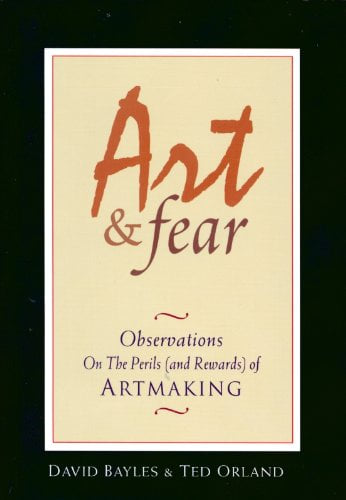
Art & Fear: Observations on the Perils (and Rewards) of Artmaking
becoming an artist consists of learning to accept yourself, which makes your work personal, and in following your own voice, which makes your work distinctive.
David Bayles, Ted Orland • Art & Fear: Observations on the Perils (and Rewards) of Artmaking
Lesson for the day: vision is always ahead of execution — and it should be. Vision, Uncertainty, and Knowledge of Materials are inevitabilities that all artists must acknowledge and learn from: vision is always ahead of execution, knowledge of materials is your contact with reality, and uncertainty is a virtue.
David Bayles, Ted Orland • Art & Fear: Observations on the Perils (and Rewards) of Artmaking
vision is always ahead of execution — and it should be.
David Bayles, Ted Orland • Art & Fear: Observations on the Perils (and Rewards) of Artmaking
To all viewers but yourself, what matters is the product: the finished artwork. To you, and you alone, what matters is the process: the experience of shaping that artwork. The viewers’ concerns are not your concerns (although it’s dangerously easy to adopt their attitudes.) Their job is whatever it is: to be moved by art, to be entertained by it,
... See moreDavid Bayles, Ted Orland • Art & Fear: Observations on the Perils (and Rewards) of Artmaking
That moment of completion is also, inevitably, a moment of loss — the loss of all the other forms the imagined piece might have taken. The irony here is that the piece you make is always one step removed from what you imagined, or what else you can imagine, or what you’re right on the edge of being able to imagine.
David Bayles, Ted Orland • Art & Fear: Observations on the Perils (and Rewards) of Artmaking
Uncertainty is the essential, inevitable and all-pervasive companion to your desire to make art. And tolerance for uncertainty is the prerequisite to succeeding.
David Bayles, Ted Orland • Art & Fear: Observations on the Perils (and Rewards) of Artmaking
The function of the overwhelming majority of your artwork is simply to teach you how to make the small fraction of your artwork that soars.
David Bayles, Ted Orland • Art & Fear: Observations on the Perils (and Rewards) of Artmaking
One of the basic and difficult lessons every artist must learn is that even the failed pieces are essential.
David Bayles, Ted Orland • Art & Fear: Observations on the Perils (and Rewards) of Artmaking
This is not good. After all, wanting to be understood is a basic need — an affirmation of the humanity you share with everyone around you. The risk is fearsome: in making your real work you hand the audience the power to deny the understanding you seek; you hand them the power to say, “you’re not like us; you’re weird; you’re crazy.”