Ashish
@ashish
Ashish
@ashish
What is a spirit?
Spirit is the totality of existence, of which each individual is a part. You are spirit. Spirit isn't something you have, but rather what you are.
It's the vast, underlying essence of your being, like the massive part of an iceberg hidden underwater. A small visible tip of an iceberg represents the limited self-perception, while the
... See more
Legal status of euthanasia in different countries varies widely.
indian philosophy and mahabharata
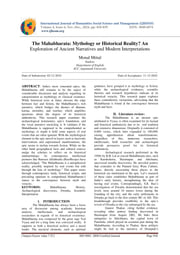
The paper investigates whether the Mahabharata should be seen strictly as mythology, as real history, or as a convergence of both, analyzing archaeological, literary, genetic, and astronomical evidence.
Myth vs. History:
The Mahabharata contains clear mythological elements: divine interventions, supernatural events, and moral allegory.
However, geographic accuracy, cultural details, and certain archaeological findings imply historical foundations beneath the legendary stories.
Prominent personalities (Ranveer Allahbadia, etc.) view the Mahabharata as "metaphorical reality."
2. Archaeological Evidence:
Excavations at sites like Kurukshetra, Hastinapur, and Ahichatra by B.B. Lal uncovered Painted Grey Ware pottery, tying these places to the Mahabharata era.
Marine archaeology at Dwarka (S.R. Rao) revealed submerged city remains and artifacts aligning with the epic's account of flooded Dwarka.
Other pottery findings and city remains reinforce the possibility of historical events underlying specific stories in the Mahabharata.
3. Genetic and Demographic Evidence:
Nilesh Nilkanth Oak and geneticist Monica Karmin argue that the massive male death toll described after the Kurukshetra War led to a genetic "bottleneck."
Modern genetic data (Y-chromosome diversity) shows a sharp reduction in male lineages around 7,500 years ago (matching the proposed war date of 5561 BCE), especially in South Asia. This suggests a real, catastrophic population event that could align with the war narrative.
4. Astronomical Dating:
Studies of references to eclipses and planetary alignments in the Mahabharata (Bijan Kumar Gangopadhyay) date the war to around 3102 BCE, close to other calculations by ancient scholars (Tilak, Aryabhatta).
These findings support the view that the epic encodes actual celestial observations and events.
5. Myth, Science, & Cultural Interpretation:
Some miraculous events (like embryo transfer, flying vimanas) could be early, mythologized references to advanced technologies (surrogacy, aeronautics), hinting at scientific knowledge encoded in myth.
Scholars like Romila Thapar and Wendy Doniger stress the Mahabharata's value as both a cultural mythos and a possible window into real history, with narrative fairy tales used to convey philosophy and dharma (ethics).
6. Conclusion:
The Mahabharata blends mythology, history, and philosophy. Ongoing archaeological, genetic, and astronomical research continues to clarify its foundations. It should be approached as a document recording the social, ethical, and possibly historical evolution of ancient Indian civilization, rather than as pure myth or literal fact. The boundary between fiction and history remains porous, but research increasingly supports the idea that the epic is rooted in substantive historical realities, dramatized and encoded in India's most revered narrative.
indian philosophy and mahabharata
Nilesh Oak argues that modern genetic evidence for a dramatic and male-specific bottleneck around 7,500 years ago, centered in India, is best explained by the catastrophic population loss described in the Mahabharata war. He connects genetics, archaeology, and ancient narrative, proposing the Mahabharata war as a scientifically plausible historical event with lasting demographic and genetic effects visible in today's populations.
Developed out of the aesthetic philosophy of cha-no-yu (the tea ceremony) in fifteenth-century Japan, wabi-sabi is an aesthetic that finds beauty in things imperfect, impermanent and incomplete. Taken from the Japanese words wabi, which translates to less is more, and sabi, which means attentive melancholy, wabi-sabi refers to an awareness of the transient nature of earthly things and a corresponding pleasure in the things that bear the mark of this impermanence. In addition to presenting the philosophy of wabi-sabi, this book includes how-to design advice—so that a transformation of body, mind and home can emerge.
Divine Force and Consciousness
- Threefold supreme births of divine force in the world:
- Truth
- Immortal element in mortals
- Divine powers working within humans
- Individual human quest reflects universal evolutionary movement