Process
My favorite way to learn is now uploading a bunch of source material to AI and then doing this:
“Help me understand this paper step by step. Go from high level (simple explanations) to incredibly low-level, detailed technical explanations until I understand it. Do not advance without confirming that I understand each... See more
Suhailx.com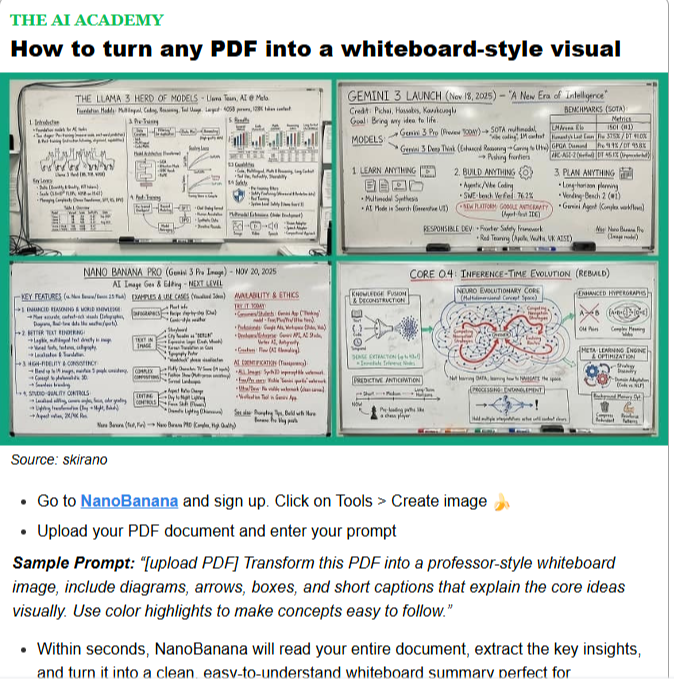
“[upload PDF] Transform this PDF into a professor-style whiteboard image, include diagrams, arrows, boxes, and short captions that explain the core ideas visually. Use color highlights to make concepts easy to follow.”
As the tools evolve, the metaphors we use to understand them must also be updated. Herndon and Dryhurst describe this next phase as the move from sampling to spawning. Sampling was the logic of the 20th century. You took a slice of a record—a James Brown breakbeat, a horn stab from a jazz LP—and folded it into a new track. It was transformative,... See more
Frank Chimero • Frank Chimero · Beyond the Machine
In other words, every new technology promises better clarity, yet its essence is determined by the noise it produces. The friction of limits is what gives a technology its character, so when a system becomes too smooth, too all-encompassing, or too accommodating, it stops having a signature at all. Here’s Eno again from earlier this year:
“I can see... See more
“I can see... See more
Frank Chimero • Frank Chimero · Beyond the Machine
I wouldn’t want an irregular AI in my bank app, but in a creative workflow, hallucinating feels like the point of it all.
Frank Chimero • Frank Chimero · Beyond the Machine
The Solution: The 30-Second Framework
After wasting dozens of hours on the wrong AI tasks, I developed a simple framework.
Before touching AI, I ask three questions. Takes 30 seconds. Saves hours.
The 3 Questions
1. CLARITY: Do I know exactly what I want?
2. SPEED: Can I do this manually in... See more
After wasting dozens of hours on the wrong AI tasks, I developed a simple framework.
Before touching AI, I ask three questions. Takes 30 seconds. Saves hours.
The 3 Questions
1. CLARITY: Do I know exactly what I want?
- YES = Maybe AI can help
- NO = Start solo to get clarity first
2. SPEED: Can I do this manually in... See more
When NOT to Use AI: The 30-Second Decision That Saves 3 Hours
If I believe my inner world is an “ecology” and social media’s algorithms are “incursions” and “extractive”—then I have to think hard about my own part in sustaining the fragile space of my attention, a place I’ve been cultivating with great care all these years.
Lia Purpura Published • The Ecology of Attention
Hall of Mirrors
sites.google.com
A site dedicated to reflection and reflective practice.