Capstone- Death of Comedy
With half a dozen more remakes in production and development, Disney are at genuine risk of running out of animated films to remake – next year’s Lilo and Stitch is the first remake to be based on a film from this century, but it will be knocked out of the park a few months later by Moana , coming out less than eight months after the animated Moana... See more
Why We're Stuck In An Endless Hell of Live Action Remakes
Up until the brink of the Depression, the companies were rolling in money. In 1931, average yearly income for a full-time, regularly employed writer was more than $14,000—roughly $273,000 in today’s money—more than three times that of the average American.
But in 1933, both MGM and Paramount Pictures cut screenwriters’ pay by 50 percent,
But in 1933, both MGM and Paramount Pictures cut screenwriters’ pay by 50 percent,
Daniel Bessner • The Life and Death of Hollywood, by Daniel Bessner
Hollywood looked like a gold mine: the studios and entertainment corporations were ripe with redundancies and inefficiencies to be axed—costs to be cut, parts to be sold, profits to be diverted to shareholders, executives, and new, often unrelated ventures. And thanks to the deregulation of the preceding decades, the industry was wide open.
Daniel Bessner • The Life and Death of Hollywood, by Daniel Bessner
Disney, General Electric, News Corporation, Sony, Time Warner, and Viacom—controlled every major movie studio and broadcast network, and a substantial portion of the profitable cable businesses. The conglomerates were raking in more than 85 percent of all film revenue and producing more than 80 percent of American prime-time television.
Daniel Bessner • The Life and Death of Hollywood, by Daniel Bessner
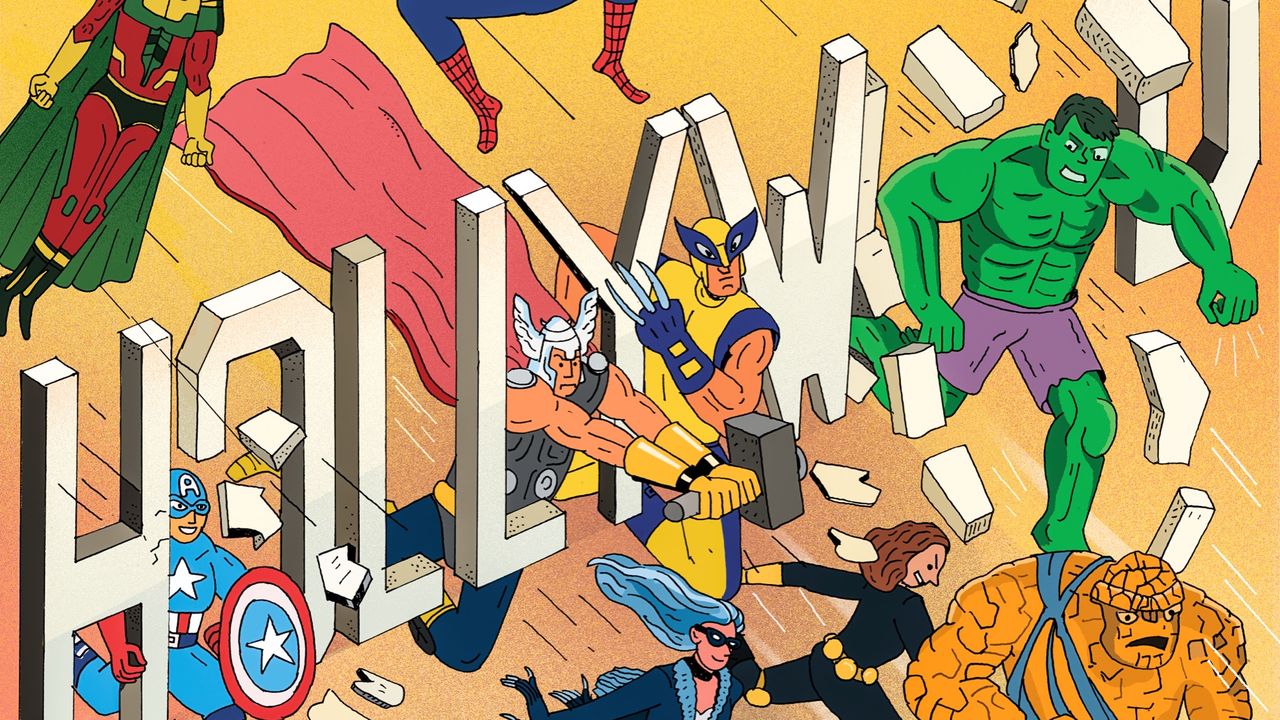
Collectively, the M.C.U. movies—the thirty-second, “Guardians of the Galaxy Vol. 3,” opened in May—have grossed more than twenty-nine billion dollars, making the franchise the most successful in entertainment history.
Michael Schulman • How the Marvel Cinematic Universe Swallowed Hollywood
Vanguard, for example, owned the largest stake in Disney, Netflix, Comcast, Apple, and Warner Bros. Discovery. It holds a substantial share of Amazon and Paramount Global. By 2010, private-equity companies had acquired MGM, Miramax, and AMC Theatres, and had scooped up portions of Hulu and DreamWorks. Private equity now has its hands in Univision,... See more
Daniel Bessner • The Life and Death of Hollywood, by Daniel Bessner
In the seventies, “Jaws” and “Star Wars” gave Hollywood a new model for making money: the endlessly promoted summer blockbuster. The M.C.U. multiplied the formula, so that each blockbuster begets another. David Crow, a senior editor for the Web site Den of Geek, calls it a “roadmap for a product that never ends.”
Michael Schulman • How the Marvel Cinematic Universe Swallowed Hollywood | The New Yorker
Dissenters have been loud. In 2019, Martin Scorsese pronounced Marvel movies “not cinema,” earning the undying enmity of comics fans. Last year, Quentin Tarantino lamented Marvel’s “choke hold” on Hollywood and said, “You have to be a hired hand to do those things.”
Michael Schulman • How the Marvel Cinematic Universe Swallowed Hollywood