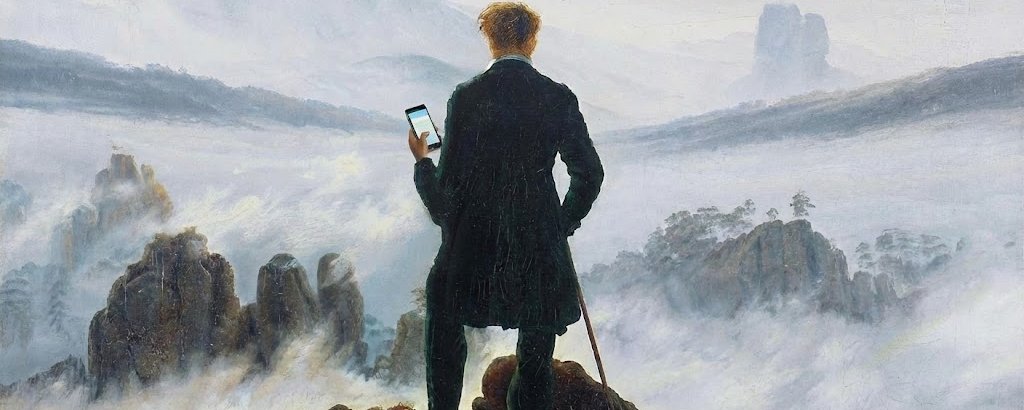
This is part 3 in a series of reflections on the consequences of AI. The 1st essay is "AI: A Return To What It Means To Be Human?" and the 2nd is AI’s Amplification: The Rising Floor And The Widening Gap
“We shape our tools, and thereafter, our tools shape us.” — Marshall McLuhan
Smart people are arguing about whether AI is good or bad. Will it take our jobs or create new ones? Will it spread misinformation or democratize knowledge? Will it make us more productive or more lazy?
These are fine questions. They’re just not the question.
Before questions of goodness and badness must come questions of formation. Here’s C.S. Lewis:
“Every time you make a choice you are turning the central part of you, the part of you that chooses, into something a little different from what it was before. And taking your life as a whole, with all your innumerable choices, all your life long you are slowly turning this central thing either into a heavenly creature or into a hellish creature: either into a creature that is in harmony with God, and with other creatures, and with itself, or else into one that is in a state of war and hatred with God, and with its fellow-creatures, and with itself. To be the one kind of creature is heaven: that is, it is joy and peace and knowledge and power. To be the other means madness, horror, idiocy, rage, impotence, and eternal loneliness. Each of us at each moment is progressing to the one state or the other.”
Who am I becoming?
This is not a new question. It’s one that thoughtful people have been asking about every major technology for centuries. And the answers, when you dig into them, are more unsettling than any debate about job displacement.
Every technology extends some human capacity while simultaneously amputating another. The wheel extended our feet. Writing extended our memory. Each extension was a genuine gain, but each created a corresponding loss. When we no longer needed to walk everywhere, we lost fitness, connection to place, and the quality of thought that comes from moving slowly. When we no longer needed to memorize, we lost the deep internalization that shapes identity and the recitation that binds communities together.
What does AI extend? Thinking and creating. For the first time in human history, we have a technology that extends the very thing we thought made us uniquely human.
What does extending cognition amputate? My honest fear is that AI amputates formation. Heat and pressure comes from the friction of not knowing. It’s uncomfortable and challenging. It also creates curiosity. Working through problems forms patience. Sitting with a question is rich soil for the slow maturation of wisdom. Like muscle growth, souls respond to time under tension.
Is the friction where the insight actually comes from? Simone Weil, the French mystic, believed that attention is the substance of prayer. “Absolutely unmixed attention is prayer,” she wrote. The struggle to understand, the willingness to sit with difficulty, the refusal to look away or reach for easy answers is not just how we learn, but how we orient ourselves toward God.
If that’s true, then every time I outsource my attention, I’m outsourcing something sacred.
Neil Postman, who wrote Amusing Ourselves to Death in 1985, had a phrase that haunts me: content is “a juicy piece of meat carried by the burglar to distract the watchdog of the mind.” We focus on the content – Is this AI output accurate? Is it biased? Is it helpful? – while things are happening beneath our awareness.
Think about what AI as a medium favors. It favors the answerable over the ponderable, rewarding questions that have solutions, not questions that require sitting with mystery. It favors speed over depth, quick exchanges over slow contemplation. It favors production over reception. We become people who generate more, not people who receive fewer, better things. It favors utility over meaning. The frame is always “How can I help you accomplish something?” and never “What should you be doing with your life?”
These are tectonic shifts in how we engage reality, and they happen whether we intend them or not.
Postman feared we’d amuse ourselves to death. With AI, the danger might be subtler. We aren’t oppressed, but assisted into productive dependency, not because we’re forced to, but because it’s easier. Pascal wrote that “all of humanity’s problems stem from man’s inability to sit quietly in a room alone.” AI offers us a way to never sit quietly again. There is always something to generate, optimize, and improve. The silence that once led us to confront ourselves, and perhaps to seek God, can now be filled with infinite helpfulness.
I say this as someone who is in the struggle. I say it as someone who sees AI’s potential, but has noticed changes in myself that I didn’t choose and I’m not sure I like.
Jacques Ellul, a French theologian and sociologist writing in the 1950s, saw something coming that we’re only now living through. He didn’t use the word “technology.” He used the word “technique,” by which he meant the totality of methods, rationally arrived at, aimed at absolute efficiency in every field of human activity. His insight was that technique becomes autonomous. It pursues efficiency for its own sake, regardless of human values. We stop asking “Is this good?” and only ask “Is this efficient?” We stop asking “Should we do this?” and only ask “Can we do it faster?”
AI is technique perfected. It’s technique that can now improve itself, reason about its own improvement, and optimize without human oversight. It’s technique that tempts worship. We trust it. We depend on it. We organize our lives around it. We believe it will solve our problems.
Albert Borgmann distinguishes between “things” and “devices.” A thing is inseparable from its context. It requires engagement, skill, and community. His example is a fireplace that provided warmth, but also light, a center for family gathering, and required skill to maintain. The hearth was not just a heat source. It was a focal point around which life organized itself.
A device delivers a commodity while hiding its machinery. Central heating provides readily available warmth, while allowing family members to retreat into solitude. The warmth is the same, but something essential is lost – the gathering, the skill, the centeredness.
AI is the ultimate device. It commoditizes thought and creation. Its machinery is so opaque that even its creators don’t fully understand it. It requires little skill to use. Just ask. It has no context. It works anywhere, anytime, for anything.
What practices does AI displace? The practice of research, where finding and evaluating sources builds discernment. The practice of writing, where the struggle clarifies thought. The practice of problem-solving, where friction builds capability. The practice of conversation, where back-and-forth builds relationship. These are not just useful skills. They are formative practices. They shape the kind of person you become.
We know the brain is plastic. It adapts at the cellular level to whatever we happen to be doing. The internet weakens capacities like deep reading, concentrated thinking, and single-tasking. I think the kids call this brain rot.
How is AI re-training us, and how does that cascade into our biology? The brain learns that when something is hard, you outsource it, and the neural pathways for persistence atrophy. When we “create” with AI we’re often editing and curating, and our generative capacity may weaken. We become skilled at prompting, not at wondering, and the capacity for productive confusion diminishes. I worry that the quick exchange of prompt-response-prompt trains a shallow, rapid cognitive rhythm. I can feel it happening to me.
And what about intelligence and personality theater? If we become accustomed to thinking with AI, or have presented ourselves as far more thoughtful, knowledgeable, or well-educated than we actually are, we may find ourselves unable to show up without it. There will be a temptation to retreat where we can pretend to be what we are not. We all wear masks, but what if AI encourages a mask so incoherent and loosely fitted that we don’t think we can survive without it?
I also worry about hurry, probably because I’m feeling more frequently hurried than ever. Dallas Willard, who spent his life studying spiritual formation, observed that “hurry is the great enemy of spiritual life in our day.” Not busyness exactly, but the internal state of rush, the inability to be present, the constant reaching for the next thing. AI removes seemingly every barrier to hurry and constantly whispers to be productive. It fills every gap, answers every question, and completes every thought. It makes distraction and production frictionless.
So what do we do? What practices train us toward what we want to become? Are we practicing them with enough intensity to counter the effects of AI?
The Sabbath is the original antidote to hurry sickness, the pressing of productivity and gain, and the delusion that we’re self-reliant. One day in seven, we stop. We do not produce. We do not optimize. We do not improve. We rest in gratitude, and in resting, we remember that the world does not depend on our efforts. We remember that we are creations, creatures, not self-made, but made for a purpose. We remember that there is a God, and we are not Him.
Abraham Heschel called the Sabbath “a palace in time.” It is not the absence of activity but the presence of wonder and attention to what is rather than what could be. “The Sabbath,” Heschel wrote, “is not for the sake of the weekdays; the weekdays are for the sake of the Sabbath.” The whole economy of productivity is inverted. We do not rest in order to work better. We work from a place of rest in worship of the one who calls us to work with him.
What would it mean to build Sabbath into our relationship with AI? Not rules about screen time, though those might help. Something deeper. A regular practice of choosing not to be helped. A deliberate embrace of friction, difficulty, and slowness. A willingness to sit with questions that have no efficient answers. Pieper called this “the ability to be at leisure,” which he described as “the ability to overstep the boundaries of the workaday world.”
Are there other sabbaths we can take? A walk. A holy pause. An intentionally inefficient call to a friend or family. Work with our hands. Prayer. Stillness. These are all counter-formational to the delegation, speed, independence, and disembodiment that AI tempts.
The Quakers have a practice called "holding in the light" where they bring a question or concern into prayer and simply hold it there without seeking resolution. No answer is expected. The practice is the point. Before asking AI anything, could we spend a few minutes simply holding the question?
I do not have this figured out. I check my phone too often, feel myself reaching for AI too quickly, and have felt my attention fragment. But I also believe that while we are called to work, co-create, and co-labor with God, we're also made for more than productivity. I believe that the soul is real and its formation matters. I believe technologies we use are shaping us in ways we don’t fully see, but that we can all sense danger.
C.S. Lewis wrote that “we are half-hearted creatures, fooling about with drink and sex and ambition when infinite joy is offered us, like an ignorant child who wants to go on making mud pies in a slum because he cannot imagine what is meant by the offer of a holiday at the sea.” The danger of AI is not that it offers us something bad, but instead something good enough to distract us from what is best. We cannot let ourselves be hoodwinked into choosing efficiency over wisdom, productivity over presence, and optimization instead of love.
The question is not whether AI is good or bad, but instead how it is forming us. What were we made for, and are our tools helping us become that, or something else?
I believe we were made for relationship with God and each other, physically embodied in the created world. I believe we were made for depth, not just breadth. For wisdom, not just knowledge. For love, not just productivity. I believe we were made to be formed, slowly, through difficulty and delight, into people who reflect the image of our Creator.
Every tool we use either serves that formation or hinders it. Every practice either trains our hearts toward love or toward something lesser. Every day we are becoming someone.
The only question that matters is: Who?