Saved by sari and
The state of personal knowledge management
The 5 C’s of personal knowledge management: creation, circulation, curation, collaboration, communities.
Anne-Laure Le Cunff • The state of personal knowledge management
People are being paid to think. Indie thinkers spend their time asking questions, researching niche topics, connecting ideas, and share their newly acquired knowledge online for people to consume.
Anne-Laure Le Cunff • The state of personal knowledge management
entrepreneurs and writers, these influencers rely on new dissemination tools to monetize their unique knowledge.
Anne-Laure Le Cunff • The state of personal knowledge management
in public” mindset is the digital garden, where indie thinkers cultivate their knowledge in public. For instance, the use of Git-based solutions such as GitBook lets users explore the evolution of ideas, their contributors, and the various branches of knowledge being explored.
Anne-Laure Le Cunff • The state of personal knowledge management
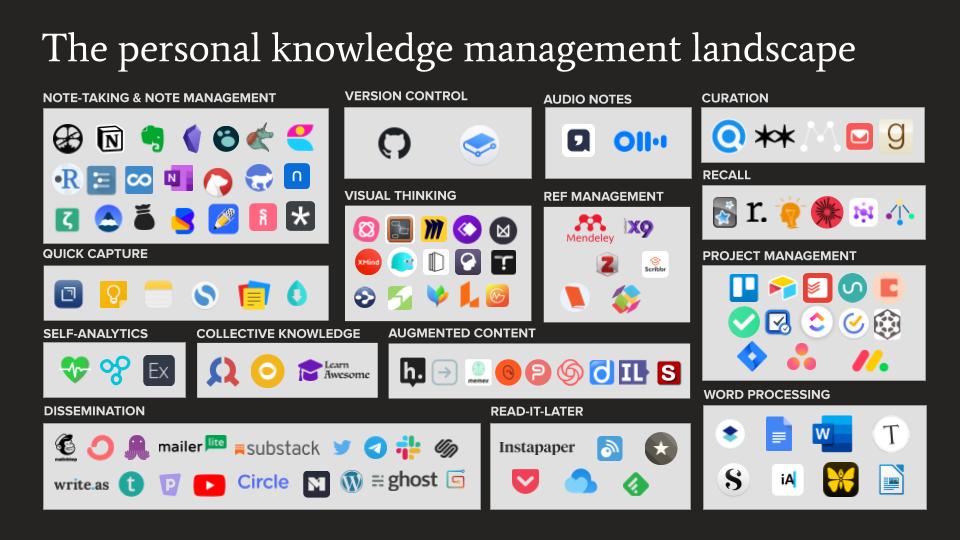
Knowledge management used to be mostly restricted to the work environment and focused on personal productivity. With the rise of the passion economy and the proliferation of indie thinkers, a new wave of personal knowledge management tools is taking over the market. Users want more than utility tools. They want tools for thought.
Anne-Laure Le Cunff • The state of personal knowledge management
Bi-directional linking in particular is experiencing a revival, originally driven by Roam Research. Notion has since launch a pared-down version of bi-directional links (which they call “backlinks”). Obsidian made it a key feature. Workflowy and Dynalist have both announced their soon-to-be-launched versions of bi-directional links
Anne-Laure Le Cunff • The state of personal knowledge management
From fragmentation to integration: more recently, Memex has launched a feature which allows users to export highlights and notes to many formats and platforms, including Roam Research. However, while these signs of integration are promising, many tools for thought are still currently hard to work with together, and multi-tools workflows can be... See more
Anne-Laure Le Cunff • The state of personal knowledge management
Beyond collecting and storing information, new tools for thought allow users to resurface, connect, and generate knowledge. Whether visual or textual, this new breed of tools encourage users to link their ideas together, find interesting patterns, and create original content based on their research.
Anne-Laure Le Cunff • The state of personal knowledge management
Finally, new tools for thought help users learn and recall information, often by using spaced repetition, whether through flashcards or daily digests