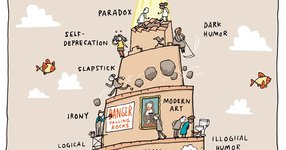
The Hierarchy of Humor (from 2016)
I wonder if all jokes boil down to the same pattern that eventually gets layered and complexified by veteran comedians. A joke is made by creating a frame with an embedded assumption, and then using a punchline to break the frame and reveal an implied truth. There are two layers of subtext, the assumption (the undertone), and the post-punchline
... See moreIt isn’t always easy to get a laugh. The ability to evoke this simplest of human responses—laughter in another person—can require not only an intuitive grasp of language (from puns to slips of the tongue), but a deep knowledge of shared cultural contexts and conventions, to say nothing of a good sense of timing. So it shouldn’t come as a surprise... See more
Galerie
as science writer Corinne Purtill states in regard to the hurdles encountered by AI engineers, “To understand a person’s humor is to know what they like, how they think and how they see the world.” An artificial intelligence with humor would have to know us better, in a sense, than we know ourselves.
Galerie
How to Write Funny and The Hidden Tools of Comedy. I forgot where I found these recommendations, but now that I look them up and see their mass-market covers and promises, I’m skeptical. Can you learn comedy from a book? I’d think a better method is to actually laugh at something, rewind, and then figure out why it works.
It takes a particular understanding of what, exactly, you’re making a joke about, and to what end, in order for dry humor to be delivered and received effectively.