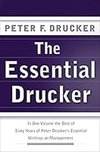
The Essential Drucker
Again and again in business history, an unknown company has come from nowhere and in a few short years overtaken the established leaders without apparently even breathing hard. The explanation always given is superior strategy, superior technology, superior marketing, or lean manufacturing. But in every single case, the newcomer also enjoys a
... See morePeter F. Drucker • The Essential Drucker
To satisfy the customer is the mission and purpose of every business. The question, What is our business? can, therefore, be answered only by looking at the business from the outside, from the point of view of customer and market. All the customer is interested in are his or her own values, wants, and reality. For this reason alone, any serious
... See morePeter F. Drucker • The Essential Drucker
Innovation can be defined as the task of endowing human and material resources with new and greater wealth-producing capacity. Managers must convert society’s needs into opportunities for profitable business. That, too, is a definition of innovation.
Peter F. Drucker • The Essential Drucker
Until a business returns a profit that is greater than its cost of capital, it operates at a loss. Never mind that it pays taxes as if it had a genuine profit. The enterprise still returns less to the economy than it devours in resources. It does not cover its full costs unless the reported profit exceeds the cost of capital. Until then, it does
... See morePeter F. Drucker • The Essential Drucker
Common vision, common understanding, and unity of direction and effort of the entire organization require definition of “what our business is and what it should be.”
Peter F. Drucker • The Essential Drucker
The foundations have to be customer values and customer decisions on the distribution of their disposable income. It is with those that management policy and management strategy increasingly will have to start.
Peter F. Drucker • The Essential Drucker
All businesses depend on the three factors of production of the economist, that is, on human resources, capital resources, and physical resources. There must be objectives for their supply, their employment, and their development. The resources must be employed productively and their productivity has to grow if the business is to survive. There is
... See morePeter F. Drucker • The Essential Drucker
General Motors had come to own the manufacturers of 70 percent of everything that went into its automobiles—and had become by far the world’s most integrated large business. It was this prototype keiretsu that gave General Motors the decisive advantage, both in cost and in speed, which made it within a few short years both the world’s largest and
... See morePeter F. Drucker • The Essential Drucker
The want a business satisfies may have been felt by the customer before he or she was offered the means of satisfying it.