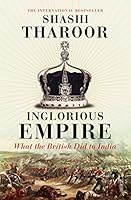
Inglorious Empire
India had enjoyed a 25 per cent share of the global trade in textiles in the early eighteenth century. But this was destroyed; the Company’s own stalwart administrator Lord William Bentinck wrote that ‘the bones of the cotton weavers were bleaching the plains of India’.
Shashi Tharoor • Inglorious Empire
The Times of India, established in Bombay in 1838, and the Calcutta Statesman (which began life in 1875, but incorporated the Friend of India which was founded in 1818) soon established themselves as reliable pillars of the establishment, solidly committed to British imperial interests but able to criticize the policies and actions of the
... See moreShashi Tharoor • Inglorious Empire
‘Considering its long history, India has had but a few hours of political and administrative unity. Its unity as a nation, however, has been firmly constituted by the sacred geography it has held in common and revered: its mountains, forests, rivers, hilltop shrines…linked with the tracks of pilgrimage.’
Shashi Tharoor • Inglorious Empire
The annual revenues of the Mughal Emperor Aurangzeb (1618–1707) were vast. Indeed, tax revenues aside, which I have mentioned earlier in the book, his total income at the time is said to have amounted to $450,000,000, more than ten times that of (his contemporary) Louis XIV.
Shashi Tharoor • Inglorious Empire
Mahatma Gandhi, who had returned to his homeland for good from South Africa in January 1915, supported the war, as he had supported the British in the Boer War. He hoped, he wrote, ‘that India, by this very act, would become the most favourite partner [of the British], and racial distinctions would become a thing of the past’. Sir Rabindranath
... See moreShashi Tharoor • Inglorious Empire
Other English-language, Indian-owned newspapers addressed themselves to Indian readers but in the awareness that their views would be paid attention to by the colonial authorities; this made them increasingly influential in the freedom movement. Arguably the most notable of these was The Hindu in Madras, established as a weekly in 1878 and
... See moreShashi Tharoor • Inglorious Empire
Rudyard Kipling, winner of the Nobel Prize for Literature and the poetic voice of British imperialism, hailed him as ‘The Man Who Saved India’.
Shashi Tharoor • Inglorious Empire
In outlining the exploitation and looting of India by British commercial interests, for example, I should acknowledge that in the process the British gave India the joint stock company, long experience of commercial processes and international trade, and Asia’s oldest stock exchange, established in Bombay in 1875. Indians’ familiarity with
... See moreShashi Tharoor • Inglorious Empire
Salman Rushdie has written of the creation of a ‘false Orient of cruel-lipped princes and dusky slim-hipped maidens, of ungodliness, fire and the sword’, endorsing Edward Said’s conclusion in his path-breaking Orientalism, ‘that the purpose of such false portraits was to provide moral, cultural and artistic justification for imperialism and for its
... See more