Google Search
Roughly 200K students graduate with MBAs annually, many of whom spend almost $200K for the privilege. That equates to $40B in aggregated annual spend. While some matriculators return to school to acquire new tangible skills and pivot their careers, many enroll for (1) high-quality network expansion beyond their undergraduate and siloed professional... See more
Aashay Sanghvi • Not Found
utilitarian framing of education: how does this make me more hirable
humanistic framing of education: learning how to think deeply and solve problems
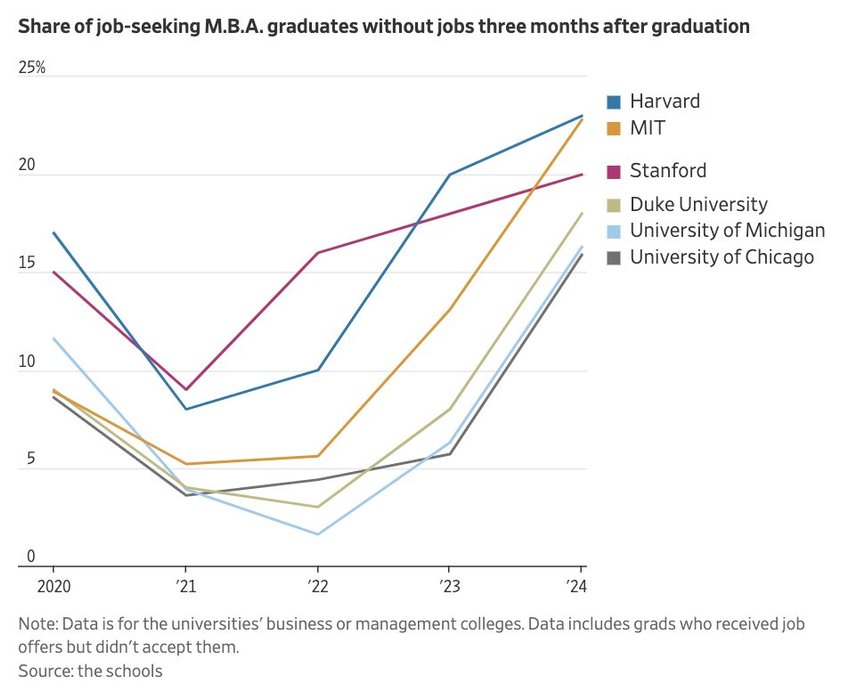
The share of elite MBA grads still looking for work 3+ months after graduation is up sharply at practically every high-ranking school.
The traditional elite-MBA absorption process—1) Get degree; 2) Glide path to Big Tech/Consulting—seems disrupted. https://t.co/cceU3DSkOL
An open secret about business school, conceded by most graduates after a drink or two, is that you aren’t spending $200,000 for the education. Sure, a good program will teach students technical skills, like how to read a 10-K or employ the case method. But the real value of a top-tier MBA is more intangible. It’s the shared language and lifelong... See more
Ikya Kandula • fastcompany.com
You would think that going to school is about learning and acquiring skills, but then why do students pay tens of thousands of dollars for Ivy League schools when all of the learning material is effectively available online for free? Why do we use grading systems when we know that students learn worse when being graded? The answer, again, is... See more