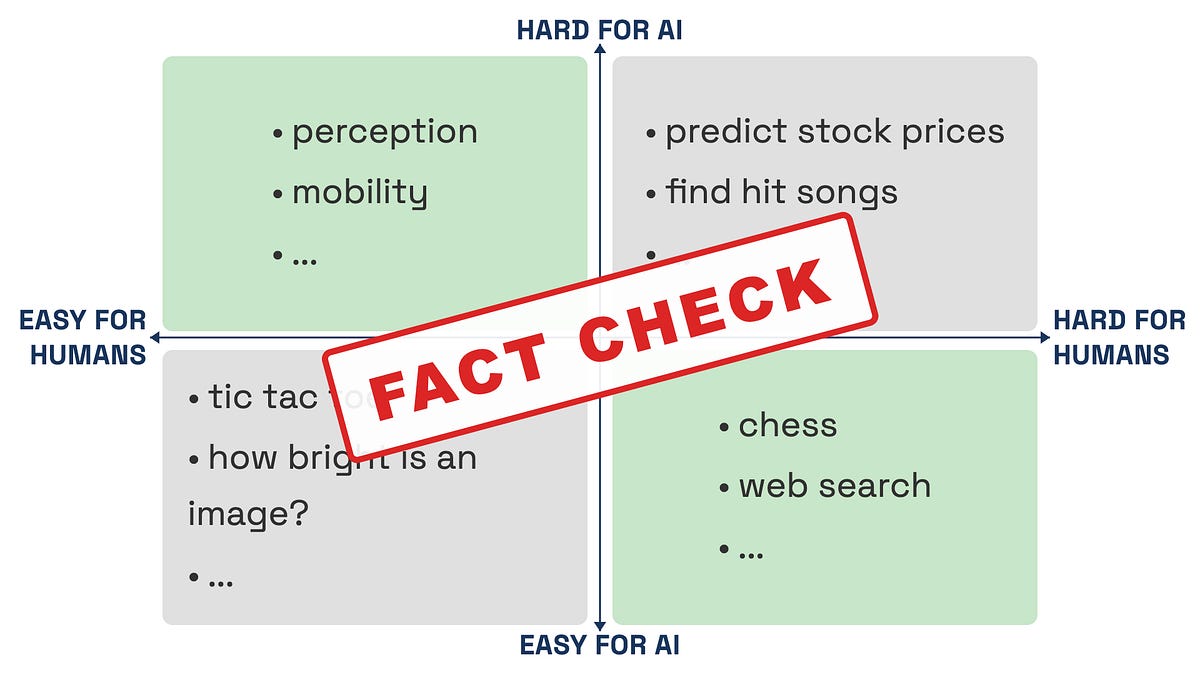
Fact checking Moravec's paradox
Moravec’s Paradox is the observation that high-level reasoning (e.g., chess, math) is relatively easy for computers to perform, while simple sensory tasks (e.g., perception, reflexes, mobility) are much harder.
Moravec believed that most people thought this result was the opposite of what most people expected,
Moravec believed that most people thought this result was the opposite of what most people expected,
It is comparatively easy to make... See more
Matt Rickard • Moravec's Paradox
I see a lot of different forms of cope. Most notably:
- People who think that those AI-generated summaries that come up when you Google something are State-of-the-art
- People who haven’t played with these models since early GPT-4, or even GPT-3.5
- People who latch onto the two big remaining error classes
- Tokenizer errors. These are what happens when you
We need to do something about AI now
Generative AI challenges us intellectually. John Searle at Berkeley talked about the Chinese Room argument. ( It says that no matter how smart a computer seems, it can’t have human consciousness.–Ed ) Well, the Chinese Room showed up. I recently gave an example. I used Google to give me a Chinese output for: “Who is Ai Weiwei?”