Entangled Life: How Fungi Make Our Worlds, Change Our Minds and Shape Our Futures
amazon.com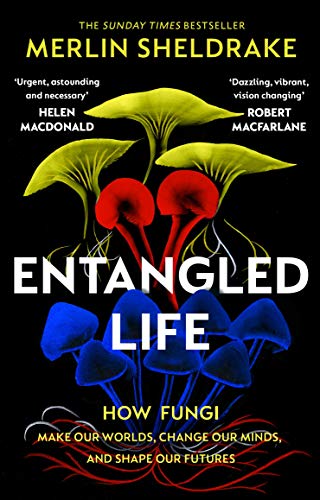
Entangled Life: How Fungi Make Our Worlds, Change Our Minds and Shape Our Futures
What we call ‘plants’ are in fact fungi that have evolved to farm algae, and algae that have evolved to farm fungi.
To grow mushrooms on any kind of scale, growers have to develop a keen nose for material to satisfy voracious fungal appetites. Most mushroom-producing fungi thrive on the mess that humans make. Growing cash crops on waste is a kind of alchemy. Fungi transform a liability with negative worth into a product with value. A win for the waste producer,
... See moreJapanese researchers released slime moulds into petri dishes modelled on the Greater Tokyo area. Oat flakes marked major urban hubs and bright lights represented obstacles such as mountains – slime moulds don’t like light. After a day, the slime mould had found the most efficient route between the oats, emanating into a network almost identical to
... See moreOther researchers are approaching the problem from a different angle. If humans have unthinkingly bred varieties of crops that form dysfunctional symbioses with fungi, surely we can turn around and breed crops that make high-functioning symbiotic partners? Field is taking this approach, and hopes to develop more co-operative plant varieties, ‘a new
... See moreEcology describes the study of the relationships between organisms and their environments: both the places where they live and the thicket of relationships that sustain them.
Mycorrhizal mycelium is a sticky living seam that holds soil together; remove the fungi, and the ground washes away. Mycorrhizal fungi increase the volume of water that the soil can absorb, reducing the quantity of nutrients leached out of the soil by rainfall by as much as 50 per cent.
In this way, a bacterium can acquire characteristics ‘ready-made’, speeding up evolution many times over. By exchanging DNA, a harmless bacterium can acquire antibiotic resistance and metamorphose into a virulent superbug in a single move.
One of the ways fungi might help save the world is by helping to restore contaminated ecosystems. In ‘mycoremediation’, as the field is known, fungi become collaborators in environmental clean-up operations.
One bacterium could acquire a trait from another bacterium ‘horizontally’. Characteristics acquired horizontally are those that aren’t inherited ‘vertically’ from one’s parents. One picks them up along the way. We’re used to the principle. When we learn or teach something, we’re part of a horizontal exchange of information.