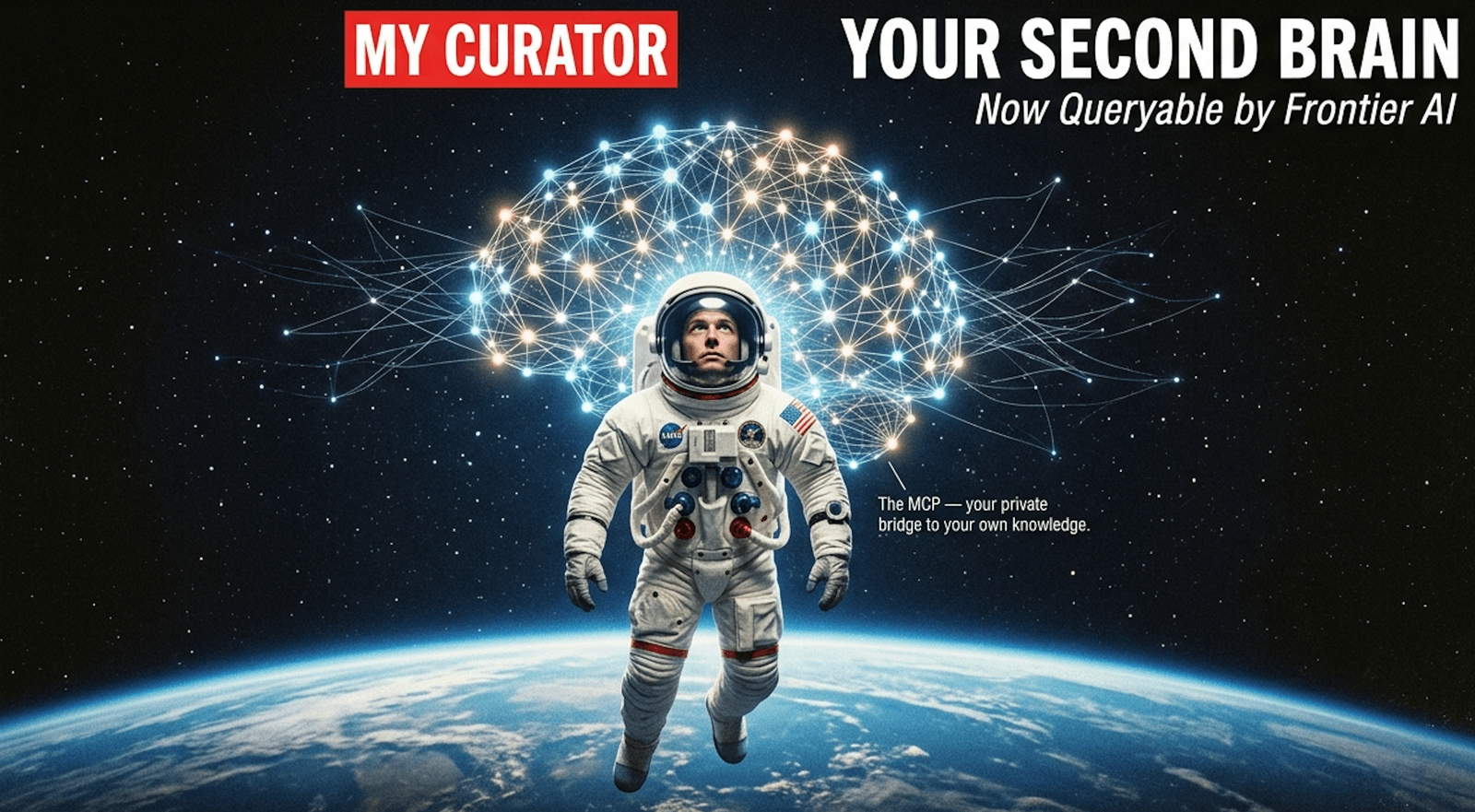
Your AI assistant knows everything about the world.
It knows nothing about you.
Not about the 200 articles you have read this year. Not about the competitive landscape you spent three months mapping. Not about the framework you quietly built from 10 years of client work that you have never written down as a single document.
That expertise lives scattered — across notes, PDFs, bookmarks, and your own memory. Every time you open an AI chat, you start from zero.
This is the problem I have been quietly solving with The Curator.
The idea is straightforward: instead of feeding AI your raw documents every time you have a question, you build a structured knowledge graph — a second brain — that compounds over time. Every article, paper, or report you ingest is atomised into interconnected markdown files: entities, concepts, and summaries, woven together by links your AI can actually traverse.
But building the graph is only half the battle.
Here is what nobody tells you about second brains: maintenance kills them.
Broken links. Orphaned pages. Concept nodes that drift apart as your knowledge grows. The graph degrades silently — and with it, the quality of every insight you try to extract.
This is exactly why I built My Curator MCP.
The My Curator MCP is a private bridge between your locally stored knowledge graph and any frontier AI — Claude, GPT, or a fully local model running entirely on your machine. No subscription lock-in. No data leaving your device. Your knowledge, queryable by the best reasoning engines in the world.
What it actually does:
→ 10 read tools that let your AI traverse your knowledge graph — not just keyword-search it. It traces backlinks, follows multi-hop connections, surfaces concept hubs you did not know were central to your thinking.
→ 1 write tool that saves your AI research sessions permanently into the graph. A conversation that ends with compile_to_wiki does not vanish from chat history. It becomes part of your compounding knowledge structure.
→ 6 health tools that change everything about maintenance. Your AI runs a full structural audit of your wiki, auto-fixes issues that have one clear answer, and walks you through the ambiguous ones conversationally. What used to take hours of manual link repair now happens in a focused 20-minute session.
Who is this for?
Researchers who read constantly but struggle to synthesise across 100 papers. Founders who have built deep domain knowledge but cannot easily surface it under pressure. Executives who need a strategic intelligence layer, not a generic AI assistant. Educators who want their thinking to accumulate, not evaporate between semesters.
If your work is fundamentally about what you know — and your ability to apply it faster and more precisely than anyone else — this is for you.
The third article in my Lab to Life series is live. It covers the full architecture of My Curator MCP: the 17 tools, the three core workflows (reading, writing, maintenance), the privacy architecture, and three concrete use cases that show what deep second brain research actually looks like in practice.
Links in the first comment.