In construction, on the other hand, relationships between firms are much weaker and shorter term. Project teams change frequently from project to project, and being selected for a project team is often largely a function of being the low bidder. As a result of these short term, transactional relationships, firms typically don’t spend time or effort... See more
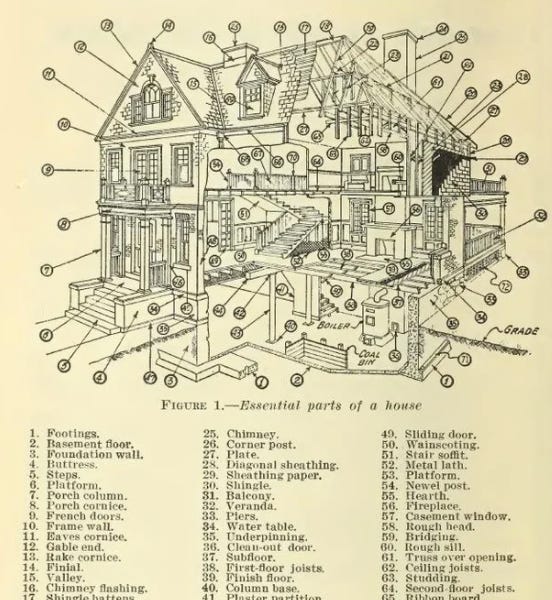
Buildings are complex artifacts: a typical single family home has somewhere in the neighborhood of 3,000 parts, and an apartment building might have 10 to 100 times as many depending on the size. For comparison, a typical car has somewhere around 30,000 parts, and a Boeing 737 has around 600,000.
This “community of practice” is what makes it possible to construct buildings at all, but it also makes it hard to innovate - any new method or technique will likely face an initial period of being worse than conventional methods.
Building production is also characterized by a great deal of uncertainty and factors outside the builder’s control. The physical environment is often difficult to predict (whoops, we got seven days of rain, whoops, we found a huge boulder when we were excavating), as is the cultural and regulatory environment (whoops, the zoning board is making us... See more
These parts are put together in a specific way, in a specific order, by dozens of different workers. Assembly tasks are highly interdependent, and each step of the process depends on the previous steps being completed successfully - install the insulation wrong, and you’ll delay the installation of the drywall, which pushes back trim, which pushes... See more
The construction industry overcomes this by relying on a set of shared standards, assumptions, and norms that exists outside of any one firm, and act as a sort of ambient coordination between firms with otherwise weak relationships.