Saved by mayamariaophilia sfaltou and
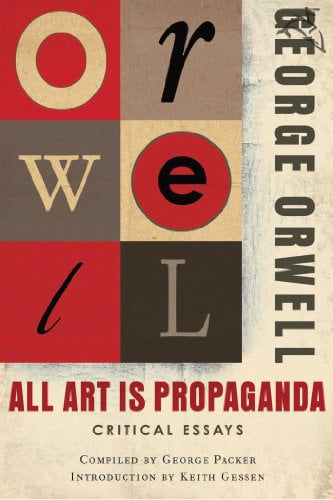
All Art Is Propaganda: Critical Essays
When one reads any strongly individual piece of writing, one has the impression of seeing a face somewhere behind the page. It is not necessarily the actual face of the writer. I feel this very strongly with Swift, with Defoe, with Fielding, Stendhal, Thackeray, Flaubert, though in several cases I do not know what these people looked like and do
... See moreGeorge Orwell • All Art Is Propaganda: Critical Essays
The essays in Facing Unpleasant Facts build meaning from telling a story; the essays in All Art Is Propaganda hold something up to critical scrutiny. The first is based on narrative, the second on analysis, and Orwell was equally brilliant at both.
George Orwell • All Art Is Propaganda: Critical Essays
Kipling is a jingo imperialist, he is morally insensitive and æsthetically disgusting. It is better to start by admitting that, and then to try to find out why it is that he survives while the refined people who have sniggered at him seem to wear so badly.
George Orwell • All Art Is Propaganda: Critical Essays
When was the last time you read a review like that?
What people always demand of a popular novelist is that he shall write the same book over and over again, forgetting that a man who would write the same book twice could not even write it once. Any writer who is not utterly lifeless moves upon a kind of parabola, and the downward curve is implied in the upward one.
George Orwell • All Art Is Propaganda: Critical Essays
Boys’ Weeklies
George Orwell • All Art Is Propaganda: Critical Essays
How the popular Boys' weeklies in England are all uniform in their portrayal of British life - alike in their antiquity and sensibility.
Then the pendulum swung away from the frivolous notion that art is merely technique, but it swung a very long distance, to the point of asserting that a book can only be “good” if it is founded on a “true” vision of life. Naturally the people who believe this also believe that they are in possession of the truth themselves. Catholic critics, for
... See moreGeorge Orwell • All Art Is Propaganda: Critical Essays
If I were forced to compare Tolstoy with Dickens, I should say that Tolstoy’s appeal will probably be wider in the long run, because Dickens is scarcely intelligible outside the English-speaking culture; on the other hand, Dickens is able to reach simple people, which Tolstoy is not. Tolstoy’s characters can cross a frontier, Dickens’s can be
... See moreGeorge Orwell • All Art Is Propaganda: Critical Essays
The fact is that the ordinary short-term case for pacifism, the claim that you can best frustrate the Nazis by not resisting them, cannot be sustained. If you don’t resist the Nazis you are helping them, and ought to admit it. For then the long-term case for pacifism can be made out. You can say: “Yes, I know I am helping Hitler, and I want to help
... See moreGeorge Orwell • All Art Is Propaganda: Critical Essays
People worship power in the form in which they are able to understand it. A twelve-year-old boy worships Jack Dempsey. An adolescent in a Glasgow slum worships Al Capone. An aspiring pupil at a business college worships Lord Nuffield. A New Statesman reader worships Stalin. There is a difference in intellectual maturity, but none in moral outlook.