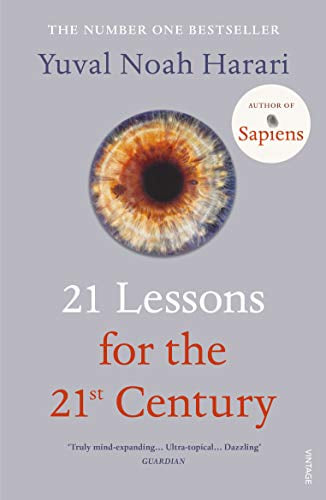
21 Lessons for the 21st Century

Art plays a key role in shaping people’s view of the world,
Yuval Noah Harari • 21 Lessons for the 21st Century
Maybe we need to turn a switch in our minds, and realise that taking care of a child is arguably the most important and challenging job in the world.
Yuval Noah Harari • 21 Lessons for the 21st Century
AI often frightens people because they don’t trust the AI to remain obedient. We have seen too many science-fiction movies about robots rebelling against their human masters, running amok in the streets and slaughtering everyone. Yet the real problem with robots is exactly the opposite. We should fear them because they will probably always obey
... See moreYuval Noah Harari • 21 Lessons for the 21st Century
The brain is a material network of neurons, synapses and biochemicals. The mind is a flow of subjective experiences, such as pain, pleasure, anger and love.
Yuval Noah Harari • 21 Lessons for the 21st Century
People are taught to believe in the story from early childhood. They hear it from their parents, their teachers, their neighbours and the general culture long before they develop the intellectual and emotional independence necessary to question and verify such stories. By the time their intellect matures, they are so heavily invested in the story
... See moreYuval Noah Harari • 21 Lessons for the 21st Century
All stories are incomplete.
Yuval Noah Harari • 21 Lessons for the 21st Century
A ritual is a magical act that makes the abstract concrete and the fictional real. The essence of ritual is the magical spell ‘Hocus pocus, X is Y!’5
Yuval Noah Harari • 21 Lessons for the 21st Century
Very few people read the latest articles in the fields of machine learning or genetic engineering. Instead, movies such as The Matrix and Her and TV series such as Westworld and Black Mirror shape how people understand the most important technological, social and economic developments of our time.
Yuval Noah Harari • 21 Lessons for the 21st Century
Global politics thus follows the Anna Karenina principle: successful states are all alike, but every failed state fails in its own way, by missing this or that ingredient of the dominant political package.