Mental Lock-in : The most subtle, but also the most dangerous type of lock-in is the one that affects your thinking. After working with a certain set of vendors and architectures, you are likely to absorb assumptions into your decision making, which may lead you to reject alternative options. For example, you may reject scale-out architectures as
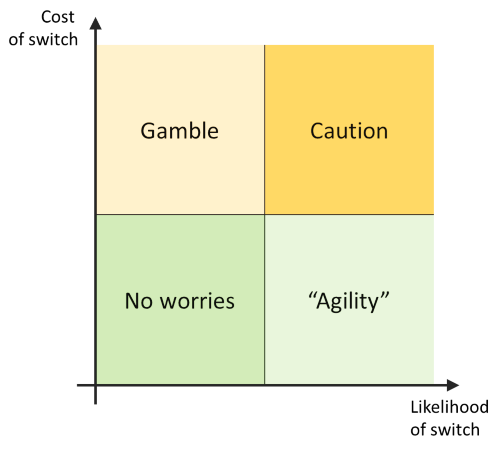
The matrix differentiates between the cost of making the switch from the likelihood that you'll have (or want) to make the switch. Things that have a low likelihood and a low cost shouldn't bother you much while the opposite end, the ones with high switching cost and a high chance of switch, are no good and should be addressed. On the other diagonal, you are taking your chances on those options that will cost you, but are unlikely to occur - that's where you'll want to buy some insurance, for example by limiting the scope of change or by padding your maintenance budget. You could also accept the risk - how often would you really need to migrate off Oracle onto DB2, or vice versa? Lastly, if switches are likely but cheap, you achieved agility - you embrace change and designed your system for low cost of executing it. Oddly, this quadrant often gets less attention than the top left despite many small changes adding up quickly. That's our poor decision making at work: the unlikely drama gets more attention because what if!
How far can we push AI autonomy in code generation?
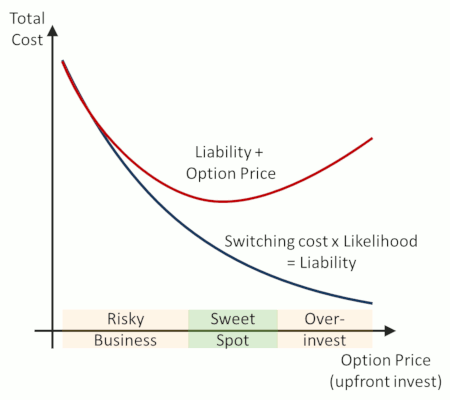
The interesting function therefore is the red line, the one that adds the up-front invest to the potential liability. That's your total cost and the thing you should be minimizing. In most cases, with increasing up-front invest, you'll move towards an optimum range. Additional investment into reducing lock-in actually leads to higher total cost. The reason is simple: the returns on investment diminish, especially for switches that carry a small probability. If we make our architecture ever-so-flexible, we are likely stuck in this zone of over-investment. The Yagni (you ain't gonna need it) folks may aim for the other end of the spectrum - as so often, the trick is to find the happy medium.
Mirador del Guavio · Ubalá, Cundinamarca, Colombia